Saudisation quotas push hotels to build Saudi talent pipelines
Hotel receptionist roles in Saudi Arabia are now reserved for nationals, with chef and senior management quotas to follow. Operators are scaling training to meet them as the kingdom's room pipeline grows.
 Steve Rogers
8 min read
Steve Rogers
8 min read
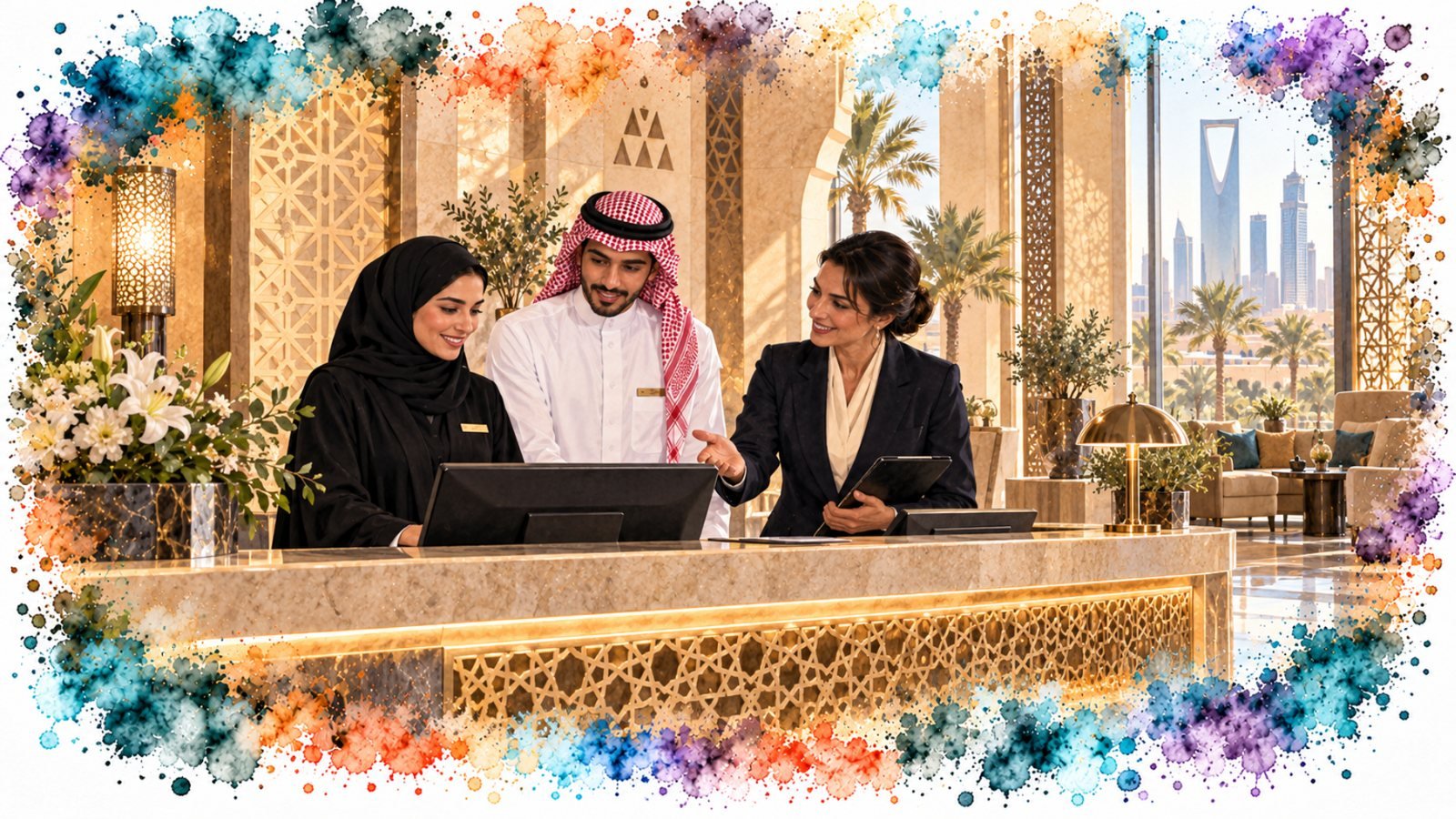
Saudi Arabia’s hotel boom is now also a recruitment test. As new quotas under the kingdom’s Saudisation policy take effect, hotel operators must fill a growing share of front-line and management roles with Saudi nationals while tens of thousands of new rooms come to market.
The Saudisation timetable for hotels
Ministerial Resolution No. 137440, issued by the Ministry of Human Resources and Social Development in April 2025, sets Saudi quotas for 41 tourism jobs. Its first phase took effect on 22 April 2026: 100% Saudi for front-desk roles such as hotel receptionist, 70% for roles including branch manager and procurement, and 50% for service roles such as restaurant host, according to law firm Clyde & Co.
Later phases set a 30% Saudi share for chef positions from early 2027, with published sources giving different start dates, and 50% for 11 senior roles from January 2028, including hotel manager, food and beverage manager and restaurant manager. Clyde & Co notes that outsourcing these roles does not exempt the employer.
A separate Ministry of Tourism policy for licensed tourism businesses requires an overall Saudi share of 40% of staff from 22 June 2026, rising to 45% from January 2027 and 50% from January 2028. It also requires hotels and other accommodation to have a Saudi receptionist on duty during operating hours.
The scale of the workforce challenge
Data from GASTAT, the national statistics authority, shows 1,009,691 people worked in tourism businesses in the third quarter of 2025, of whom 245,171, or 24.3%, were Saudi nationals. The Ministry of Tourism’s annual report, cited by Arab News, says women make up 47% of Saudi nationals working in tourism, up from 5% in 2018.
Demand will keep rising. Tourism Minister Ahmed Al-Khateeb has set a goal of about 1.6 million tourism jobs by 2030, and HVS data reported by Arab News puts about 110,000 hotel rooms in development in the kingdom, roughly half of the Middle East pipeline.
Training at destination scale
Employers and government are building pipelines rather than relying on the open market. The Ministry of Tourism’s Tourism Trailblazers scheme is a $100m initiative to train 100,000 young Saudis. Red Sea Global graduated 386 trainees in its latest cohort in June 2026, and more than 2,400 young Saudis have taken part since launch across tracks including luxury hospitality and culinary arts, Arab News reported. “Those who came through our education and training programs are already helping bring our destinations to life,” said John Pagano, Red Sea Global’s Chief Executive.
For international operators, the shift changes what talent acquisition means in the kingdom. Graduate and apprenticeship programmes, Arabic-language onboarding and clear progression to supervisor and manager roles are becoming core recruitment tools rather than extras, especially with senior-role quotas due in 2028. Leadership appointments reflect the same focus, as in our report on Fadeel Wehbe’s role with Accor’s luxury brands in Saudi Arabia.
What hotel recruiters should plan for
Practical steps include auditing roles against the 41 listed occupations and both quota schemes, building Saudi talent into chef and management succession plans now rather than in late 2027, partnering with government-backed training programmes, and tracking retention closely, because quotas count people in post rather than hires made. For broader ideas on growing talent from within, see eight strategies to fix hotel recruitment in 2026.