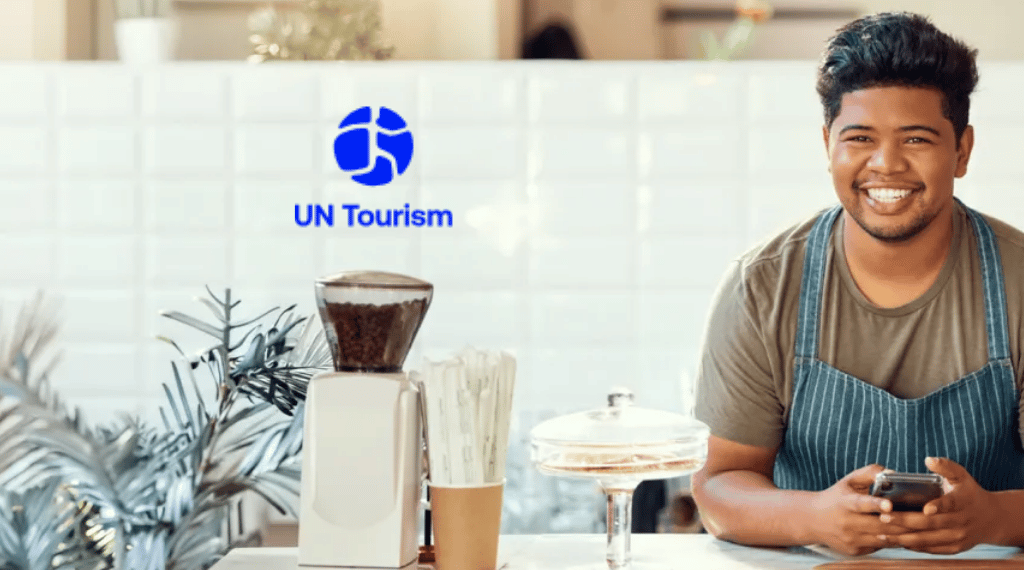
The United Nations’ specialised tourism agency has launched its first WhatsApp-delivered training programme, opening 2,000 fully subsidised places for hospitality workers, entrepreneurs and SMEs across Spain. Delivered in partnership with Fundación Mahou San Miguel, the Digital Course on Hospitality via WhatsApp marks UN Tourism’s first attempt to deploy mobile messaging as a primary training channel rather than a supporting one.
The choice of platform reflects a pragmatic reading of how frontline hospitality staff actually consume information. With more than two billion users globally, WhatsApp sits inside the daily routine of waiters, receptionists, cooks and shift supervisors who rarely have the time, the equipment or the inclination to log into a desktop learning portal.
For UN Tourism, the launch is also a signal of strategic intent. The agency’s new Secretary-General, Shaikha Al Nuwais, took office in January 2026 as the first woman to lead the body in its 50-year history, with digital transformation and economic inclusion among her stated priorities.
A pilot built around mobile-first realities
The programme targets the Spanish horeca sector: hotels, restaurants and cafés that together form the backbone of the country’s tourism economy and employ a large share of its lowest-paid, highest-turnover workforce.
Lessons are short, modular and structured for asynchronous consumption, covering day-to-day management, digital marketing, customer loyalty, sustainability and the promotion of local products and experiences. Participants who complete all modules receive a joint certificate from UN Tourism and Fundación Mahou San Miguel.
The format addresses a long-standing frustration in hospitality training. Shift patterns, seasonal demand and high churn make multi-week classroom programmes impractical for the people who most need them. Mobile microlearning, in theory, fits into a coffee break.
Why Spain, and why Mahou San Miguel
The choice of Spain is not incidental. The country is one of the world’s largest inbound tourism markets and UN Tourism’s headquarters sit in Madrid, the only UN agency with a permanent base on Spanish soil.
Fundación Mahou San Miguel, the social arm of one of the country’s largest domestically owned brewers, has spent more than a decade running hospitality training and youth employability programmes for the horeca sector. Its operational knowledge of Spanish hospitality SMEs gives the pilot a delivery partner with existing networks among the small operators the course is designed to reach.
Shaikha Al Nuwais, Secretary-General of UN Tourism, described the launch as ‘a game changer for how skills are developed across the sector’, adding that delivering training through a tool used daily by millions enables ‘immediate, applicable learning that strengthens local ecosystems and enhances the visitor experience’.
A test case, not a finished model
The framing around the launch has been notably ambitious, with several outlets describing it as a blueprint for global tourism education. The reality is more measured. The first cohort covers 2,000 learners in a single country, against a Spanish horeca workforce that runs into the hundreds of thousands. International expansion has been signalled but not scheduled.
The success of WhatsApp-based microlearning ultimately depends on metrics the sector has historically struggled to track: completion rates, skill retention and measurable impact on business performance. UN Tourism Academy’s earlier procurement documentation for mobile learning platforms has emphasised engagement data and skills development outcomes, suggesting the agency is aware that reach alone will not be enough.
For HR leaders and senior operators, the more useful read sits a level deeper. The launch validates a pattern already visible inside major hotel groups, many of which have moved compliance, onboarding and service training onto mobile channels their staff already use. If a UN agency is willing to put its name behind WhatsApp as a learning platform, the case for treating frontline mobile learning as a serious workforce strategy, rather than a novelty, becomes harder to dismiss.
What comes next
UN Tourism has indicated that the hospitality course is one strand of a broader pipeline of WhatsApp-delivered tracks, with topics including communication and customer service, tourism ambassadorship and quality guide development under consideration. The agency has not published a timetable for international rollout, nor specified which markets are likely to come next.
For now, the test is straightforward. If 2,000 Spanish hospitality workers finish the course, apply what they have learned and report measurable improvement in how they run their businesses, UN Tourism will have the evidence base it needs to scale. If completion rates disappoint or outcomes prove difficult to measure, the model will need rethinking before it travels.
Either way, the launch is a useful data point for an industry still working out how to train a workforce that rarely sits at a desk.