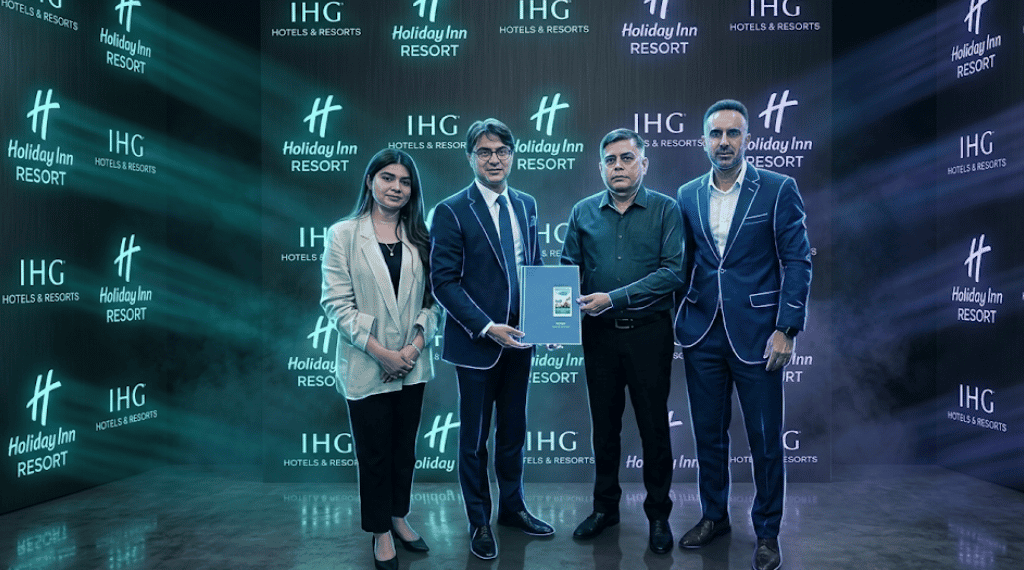
IHG Hotels & Resorts has signed a management agreement with Yash Hotels & Resorts LLP to develop Holiday Inn Resort Alwar, marking the global group’s entry into a Rajasthan destination that has until now been largely overlooked by international branded operators. The 150-key resort, set against the Aravalli hills and positioned close to Sariska Tiger Reserve, is scheduled to open in Q1 2030.
The signing adds to a development pipeline in India that IHG is scaling at pace. As of January 2026, the group operates 51 hotels in India and holds 80 further properties in development, totalling close to 12,000 rooms. India delivered a third consecutive year of record hotel signings in 2025, and the group has publicly committed to reaching more than 400 open and in-development hotels in the country within five years.
Commenting on the agreement, Sudeep Jain, Managing Director, South West Asia, IHG Hotels & Resorts, said the signing reflects the group’s confidence in the long-term potential of markets such as Alwar. ‘With its scenic setting and the strength of the Holiday Inn Resort brand, the hotel will be well positioned to meet the evolving needs of travellers,’ he said.
Why Alwar, and why now
Alwar’s appeal to hospitality investors rests on a combination of factors that are increasingly characteristic of India’s emerging leisure market: proximity to major demand centres, natural and heritage assets, and an accommodation landscape where branded supply remains thin.
The city sits approximately 150 kilometres from Delhi and around 107 kilometres from Jaipur, placing it within comfortable reach of two of India’s largest origin markets for weekend and short-break travel. Sariska Tiger Reserve, spanning more than 860 square kilometres of the Aravalli range, provides a wildlife draw that positions the destination alongside established nature-led markets such as Jim Corbett and Ranthambore.
Beyond wildlife, Alwar carries significant heritage credentials. The city’s royal past is visible through landmarks including the City Palace, Bala Quila Fort and Siliserh Lake. Bhangarh Fort, located within the broader district, draws a distinct segment of culture and heritage travellers. Together, these assets create a layered destination proposition that reduces reliance on any single travel segment.
Mukesh Gulati, Managing Partner, Yash Hotels & Resorts LLP, highlighted the opportunity explicitly. ‘The city’s proximity to key markets such as Delhi NCR and Jaipur, combined with its natural beauty and cultural heritage, makes it an ideal destination for hospitality development,’ he said, adding that the resort is expected to become a preferred choice for weddings, events and leisure stays.
A mixed-demand positioning
The resort’s configuration reflects the operational logic that now underpins much of India’s tier II and leisure market development. With 150 rooms alongside dining outlets, resort amenities and banquet and meeting infrastructure, Holiday Inn Resort Alwar is designed to serve multiple demand streams simultaneously.
Destination weddings represent a particularly significant opportunity in this segment of the market. The Alwar-Sariska belt already attracts event-led bookings to its existing resort properties, many of which operate at the upper end of the unbranded or regional-brand tier. The arrival of an internationally managed Holiday Inn Resort introduces a level of brand assurance and distribution reach that owner-operated properties in the area cannot easily replicate.
Corporate retreats form a secondary demand driver. Alwar’s road connectivity from the National Capital Region makes it a viable option for off-site events and team travel, a segment that has grown materially as organisations have increased investment in culture, engagement and leadership development initiatives.
IHG’s India engine
The Alwar signing sits within a broader momentum story for IHG in India. Holiday Inn and Holiday Inn Express together account for more than 70 per cent of the group’s operating estate in the country and the majority of its development pipeline. The Holiday Inn Resort format extends the brand’s reach into leisure destinations where the standard urban-facing Holiday Inn proposition would be a poor fit.
IHG’s India portfolio spans eight brands from Six Senses and InterContinental at the luxury end through to Garner, the group’s newest midscale conversion brand, which entered India in 2025. Rajasthan already features prominently in the luxury tier, with Six Senses Fort Barwara having opened in 2021. Holiday Inn Resort Alwar represents a different register of the group’s Rajasthan presence, targeting the aspirational leisure traveller rather than the ultra-premium segment.
The asset-light model underpinning the Alwar deal, a management agreement with a local development partner rather than an owned property, is consistent with IHG’s global approach and enables the group to grow its India footprint without committing substantial capital to individual projects.
The longer view
Alwar is one of a growing number of Indian leisure destinations that branded hospitality is beginning to take seriously. The pattern is consistent: improving road infrastructure reduces the psychological distance from metro origin markets; domestic travel demand, particularly from upper-middle-income households, continues to grow; and travellers in this cohort increasingly expect the reliability, loyalty points and service standards that only branded properties can deliver.
For Yash Hotels & Resorts LLP, the IHG partnership provides access to global distribution, a recognised brand with established leisure market credibility and the operational systems required to deliver at a standard the market currently lacks. For IHG, the deal adds a strategically positioned resort to its Rajasthan footprint at a point when competition for high-quality owner partnerships in emerging leisure markets is intensifying.
Whether Alwar develops the sustained year-round demand profile that justifies the investment at scale will depend partly on continued government investment in connectivity and destination infrastructure. The property’s Q1 2030 opening date gives the market several years to mature before the test becomes commercial.