

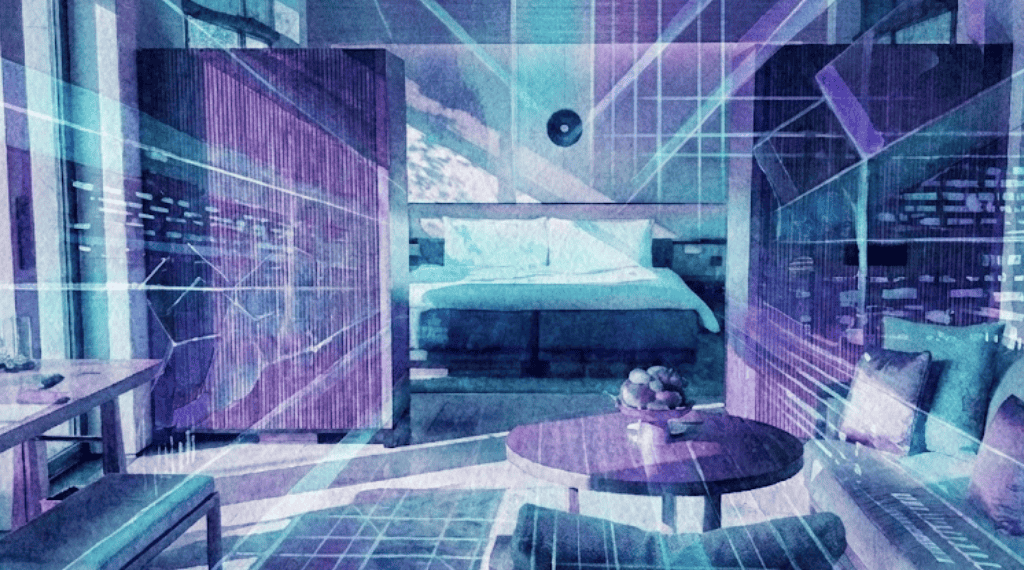

There is a quiet revolution happening in hospitality architecture. Technology, once an afterthought relegated to IT departments in the final construction phases, is becoming foundational to how we conceive buildings from the very first sketch.
For those of us who work in design, this shift demands a fundamental rethinking of our process. The question is no longer where to place the data ports or how to conceal the cabling. It is whether the building itself can learn, adapt and respond.
When buildings become intelligent
The concept of the digital twin – a virtual replica of a physical asset that updates in real time – has moved from manufacturing into hospitality construction. These dynamic models allow design teams to simulate thousands of scenarios before ground is broken: guest flow patterns at different times of day, maintenance access routes, energy consumption under varying occupancy levels.
Hilton’s LightStay platform offers a compelling example of this thinking at scale. Developed in partnership with technology firm ei3 and deployed across the company’s global portfolio, the system uses AI to model expected energy, water and waste usage against actual consumption. The results have been independently verified by KEMA and DEKRA: cumulative savings exceeding $1 billion since 2008, alongside measurable reductions in resource consumption across thousands of properties.
What interests me as a designer is not the technology itself, but what it enables. When building systems can predict and respond, the architectural brief fundamentally changes.
Disappearing controls
The most striking design trend emerging from this integration is what some are calling “switch-less architecture” – the systematic removal of physical controls from guest spaces. Light switches, thermostats, control panels: these elements that once cluttered walls are increasingly unnecessary when sensors and automation handle environmental adjustment.
Hilton’s Connected Room concept, now deployed across more than a thousand properties, allows guests to control lighting, climate and entertainment through their smartphones. The technology eliminates the need for visible hardware while enabling far more granular personalisation than traditional controls ever could.
For interior designers, this creates remarkable freedom. Wall surfaces can remain uninterrupted. Furniture placement becomes more flexible. The aesthetic vision can be realised without compromise to operational necessity.
Yet there is a balance to strike. Technology that demands guest interaction – apps to download, interfaces to learn – risks becoming its own form of friction. The most successful implementations are those where the room simply responds: adjusting to presence, anticipating need, requiring nothing of the guest at all.
The acoustic challenge
As hotel lobbies transform into hybrid spaces – part reception, part co-working hub, part social venue – acoustics have become a critical design consideration. The very liveliness that makes these spaces attractive creates noise levels incompatible with the focused work many guests now expect to accomplish.
Two responses are emerging. The first involves materials engineering: surfaces that appear as premium finishes but function as acoustic dampers, allowing designers to maintain warm aesthetics while controlling sound propagation. The second involves furniture as infrastructure: acoustic pods and privacy nooks integrated into millwork rather than dropped in as afterthoughts.
This represents a significant evolution in how we think about public space within hotels. The lobby is no longer singular in purpose. It must accommodate multiple modes of use simultaneously, and technology – embedded in materials, integrated into furniture – is what makes this possible.
Wellness beyond the spa
Perhaps the most interesting development is the automation of wellness. Circadian lighting – systems that shift colour temperature throughout the day to support natural sleep patterns – has moved from luxury positioning to mainstream expectation.
Equinox Hotels launched its Sleep Lab concept in July 2025, developed in collaboration with sleep scientist Dr Matthew Walker. The system automatically adjusts lighting, temperature, sound and ambiance based on guests’ stated sleep and wake times. No guest input required during the stay itself.
Six Senses has deployed similar thinking across its portfolio, incorporating circadian lighting into what it terms “biohacking rooms.” Industry research from the Global Wellness Institute suggests strong guest willingness to pay premium rates for sleep-enhancing accommodations.
For architects, this presents both opportunity and obligation. Environmental systems that once operated on simple schedules now require integration with sophisticated controls. Lighting design becomes not just aesthetic but biological. The building must understand the human body.
Integration as imperative
What strikes me most about these developments is not any single technology, but the imperative for early integration they collectively represent.
The properties achieving measurable returns – in energy efficiency, guest satisfaction, operational cost – are those where technology decisions were made alongside architectural ones. Where IT consultants sat with designers from day one. Where the question was never “how do we add technology?” but “how does technology shape what we build?”
This is uncomfortable territory for many in our profession. Architecture has historically concerned itself with form, space, material. The digital realm was someone else’s domain.
That distinction no longer holds. The most successful hospitality projects of the coming decade will be those where technology is invisible precisely because it was considered foundational. Where guests never notice the systems working around them because those systems were designed into the building’s very bones.
The invisible architect, it turns out, is not technology replacing us. It is technology demanding that we expand what architecture means.


