

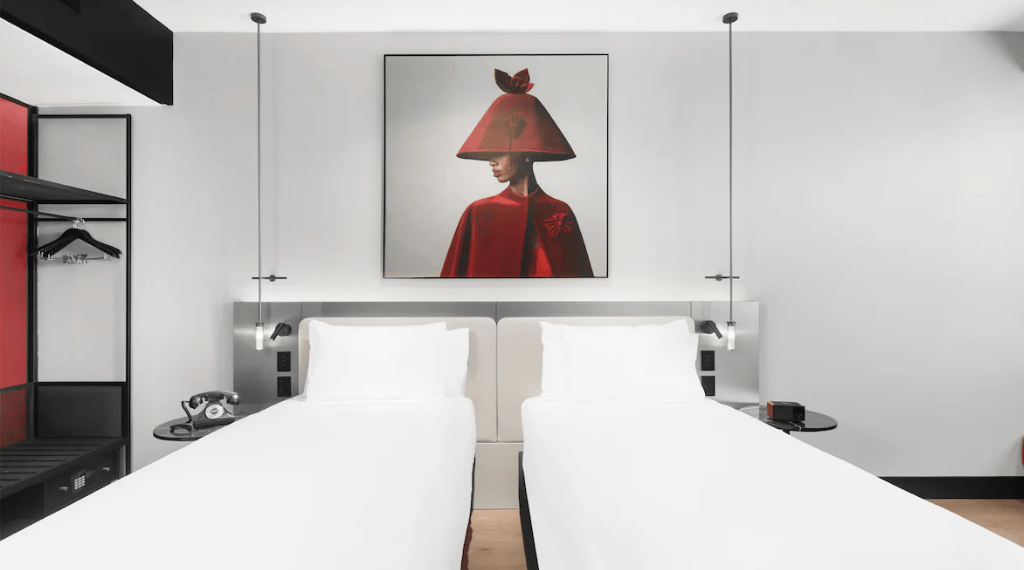

Radisson RED Auckland opened on 23 February 2026 at 33 Lorne Street in the city’s Arts District, bringing Radisson Hotel Group’s first property to New Zealand and placing the brand’s lifestyle-focused Radisson RED concept in Australasia for the first time. The 322-key hotel occupies a converted 15-storey office building developed by Auckland-based Stonewood Group, whose $100 million redevelopment of the former 280 Queen Street site – which previously housed Countrywide Bank and National Bank – creates one of central Auckland’s most prominent mixed-use hospitality developments.
The opening comes at a complex moment for the Auckland hotel market. International arrivals to New Zealand remain approximately 13 per cent below 2019 levels as of mid-2025, according to CBRE data, and Auckland’s city hotel segment has faced particular pressure, with RevPAR declining 10 per cent year-on-year through the same period as supply growth outpaced demand recovery. However, more recent data offers cause for measured optimism: the December 2025 to January 2026 summer period delivered the strongest monthly RevPAR growth New Zealand hotels had recorded in two years, with Auckland contributing to the upturn alongside Queenstown and Christchurch.
Two structural developments add longer-term weight to Radisson Hotel Group’s timing. The New Zealand International Convention Centre – long delayed after a 2019 construction fire – is scheduled to open in Auckland in 2026, with projections suggesting it could attract 33,000 additional international visitors and contribute 101,000 visitor nights annually, according to research cited by Colliers Hotels. Separately, the Aotea Station development, part of the Auckland City Rail Link project, is being built directly across from the Lorne Street address, improving connectivity to what Stonewood describes as a “throughway link” between Queen Street and the Lorne Street hospitality precinct.
Radisson RED Auckland’s design draws deliberately from the surrounding cultural infrastructure. Corridor lighting mimics stage spotlights, lounge seating references opera boxes, and guest rooms are conceived as actor’s dressing rooms – layered textures, expressive colours and sensory lighting that positions the property as an extension of the Arts District rather than a conventional hotel insertion into it. Contemporary installation pieces throughout the building reference Auckland’s gallery scene, while the overall approach reflects what General Manager Reinout Engel framed as an intent to create a creative hub rather than merely a place to stay.
The property’s most commercially significant asset may be its rooftop. A vibrant rooftop bar and event space – described by the company as the largest outdoor rooftop space in New Zealand – sits above the city with open sightlines to the Sky Tower and capacity for up to 219 guests in cocktail configuration. The rooftop can be divided into four flexible rooms for meetings, weddings, live performances and corporate events, offering the property a meaningful revenue stream beyond room nights. The rooftop restaurant and bar was not yet open at launch but is anticipated to follow shortly after opening.
“Radisson RED thrives in cities fuelled by creativity, culture, and community, and Auckland captures that spirit perfectly,” said Tim Cordon, Chief Operating Officer for MEA and SEAP at Radisson Hotel Group. “This opening marks a major milestone for our growth in Australasia and a proud moment for our upper-upscale Radisson RED brand.”
The deal structure – a lease arrangement with owner Stonewood Group – reflects a model Radisson Hotel Group has used selectively to enter markets where direct investment by operators is less conventional. The group’s Managing Director for Australasia, Lachlan Hoswell, described the arrangement as New Zealand’s largest leased hotel project at the time of the original signing. For Stonewood, the Radisson RED brand brings international distribution and loyalty access via the Radisson Rewards programme, which the group reports has more than 27 million members across Europe, the Middle East, Africa and Asia Pacific.
The Auckland entry also signals broader Australasia ambitions for Radisson Hotel Group. A Radisson RED Queenstown is already confirmed for 2028, suggesting the brand intends to build regional scale rather than treat New Zealand as a single-market experiment.
For HR and talent professionals in the hospitality sector, the opening adds a notable upper-upscale employer to Auckland’s CBD workforce landscape. The property’s events and food and beverage offering – spread across the all-day dining venue, the forthcoming rooftop restaurant and the function spaces – implies a substantial front-of-house staffing structure. In a market where hospitality recruitment remains competitive, Radisson RED’s positioning as a design-led, creatively oriented employer could prove a meaningful differentiator for attraction and retention of younger hospitality talent.
The international brand brands now operating in Auckland – which includes Hotel Indigo, which debuted in the city in 2024 – continue to broaden the market’s credentials as a destination for globally mobile travellers. Whether Radisson RED Auckland can translate that positioning into sustained commercial performance will depend significantly on how quickly international arrivals return to pre-pandemic levels. Current forecasts from New Zealand’s Ministry of Business, Innovation and Employment project full recovery in international arrivals by 2026, though some industry analysts, including the Tourism Export Council of New Zealand, place that timeline closer to 2027.

