

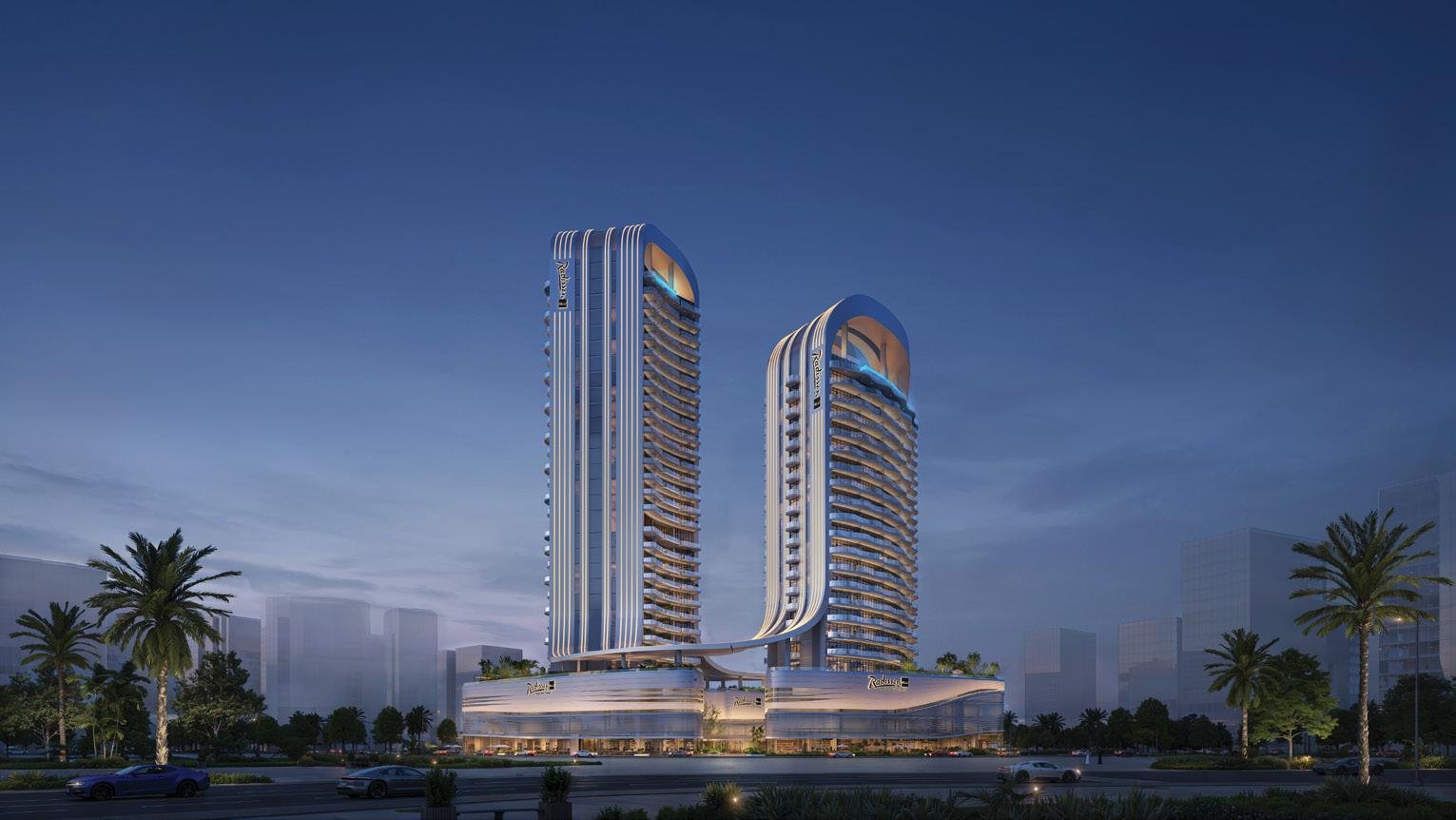

BNW Developments and Radisson Hotel Group have unveiled the first hotel to be announced for RAK Central, Ras Al Khaimah’s emerging urban business district, marking a significant expansion of the emirate’s hospitality footprint beyond its established leisure-resort corridor at Al Marjan Island.
The project comprises two components: the 361-key Radisson Blu Hotel, RAK Central, and the adjacent Radisson Blu Residences, RAK Central, which will offer 222 branded residential units. The announcement was made at a launch event attended, according to the companies, by more than 8,000 guests drawn from the real estate and hospitality industries.
A hotel designed for business and leisure convergence
The Radisson Blu Hotel will be positioned above curated retail and cinema space, creating a day-to-night destination rather than a standalone property. Facilities will include five food and beverage venues, a rooftop terrace and pool bar, meeting and event spaces, a spa and gym, a Business Class lounge, and a kids’ club – a configuration designed to attract both corporate travellers and leisure guests.
The 222 branded residences adjacent to the hotel will offer residents access to hotel-delivered services, allowing operational efficiencies to be shared across both assets. This hotel-residence model has become increasingly common across the Gulf as developers seek to blend residential investment returns with hospitality brand credibility.
BNW’s RAK Central ambitions
BNW Developments, which describes itself as the largest private developer in Ras Al Khaimah, has assembled a portfolio of more than 10 projects across the emirate according to the company. The Radisson Blu partnership represents its first foray into internationally branded hospitality within RAK Central.
Dr. (CA) Ankur Aggarwal, Chairman and Founder of BNW Developments, described the project as “a defining step” in the company’s Ras Al Khaimah vision, stating it was “conceived to deliver durable investor returns alongside a globally benchmarked living experience.” Co-founder Dr. Vivek Anand Oberoi, the company’s Managing Director, said RAK Central was “a clear statement of where Ras Al Khaimah is headed.”
For Radisson Hotel Group, the deal marks its first entry into the RAK Central district. Elie Milky, Chief Development Officer for the Middle East, NE Africa, Cyprus and Greece, said the group was “entering RAK Central for the first time” and described Ras Al Khaimah as “both an investment market and a visitor destination.”
RAK’s urban pivot
The announcement is strategically significant because it targets RAK Central rather than Al Marjan Island, which has been the dominant focus of the emirate’s hospitality investment wave. RAK Central is positioned as an integrated Live-Work-Play district combining offices, residences, hospitality, retail and lifestyle – a model more characteristic of urban business hubs than resort destinations.
This distinction matters for hospitality workforce planners. Business-oriented hotels generate different staffing profiles from leisure resorts: higher demand for MICE coordinators, corporate account managers and multilingual business services staff, alongside the typical operational roles. As RAK Central takes shape, it is likely to require a talent pipeline distinct from the predominantly leisure-focused workforce that has underpinned the emirate’s hotel growth to date.
Supply gap creates a narrow window
The announcement arrives at a moment when Ras Al Khaimah’s hospitality market is experiencing a structural supply-demand imbalance. The emirate welcomed a record 1.35 million overnight visitors in 2025 – a 6% year-on-year increase – with tourism revenues rising 12% over the same period, according to Ras Al Khaimah Tourism Development Authority (RAKTDA).
Hotel performance metrics strengthened sharply: occupancy rose 4.6 percentage points, average daily rate climbed 6.6% and revenue per available room surged 11.5% year-on-year, according to Khaleej Times analysis of market data. The emirate’s current hotel inventory exceeds 9,000 keys, but a pipeline of more than 9,500 additional rooms is expected to be delivered between 2026 and 2030, with 92% of planned supply in the five-star category.
Research by Stirling Hospitality Advisors projects that visitor demand will exceed available hotel rooms by around 1,300 keys by 2030, with the supply gap expected to emerge from 2027. Industry executives have described this as a two-to-three year window of opportunity for projects that can complete and begin trading before the broader supply wave arrives.
Workforce implications of RAK’s upmarket shift
Beyond the supply figures, Ras Al Khaimah is undergoing a deliberate repositioning away from mass-market, all-inclusive tourism towards a more affluent visitor profile. Industry leaders at the emirate’s RAK Investment Pulse event noted earlier this month that the imminent opening of the Wynn Al Marjan Island integrated resort – widely expected in 2027 – will place significant upward pressure on rates and shift the competitive environment for every operator in the market.
This transition carries direct implications for HR strategy. Hotels competing for higher-spending guests will require staff capable of delivering individualised, service-intensive experiences – a different competency profile from the standardised delivery that all-inclusive packages typically demand. For HR leaders overseeing workforce planning in the region, the shift signals a need to invest now in identifying, training and retaining talent suited to premium service environments, ahead of a supply-side surge that will intensify competition for skilled hospitality workers.
No completion timeline or total development investment figure was disclosed in connection with the Radisson Blu Hotel and Residences announcement.


