

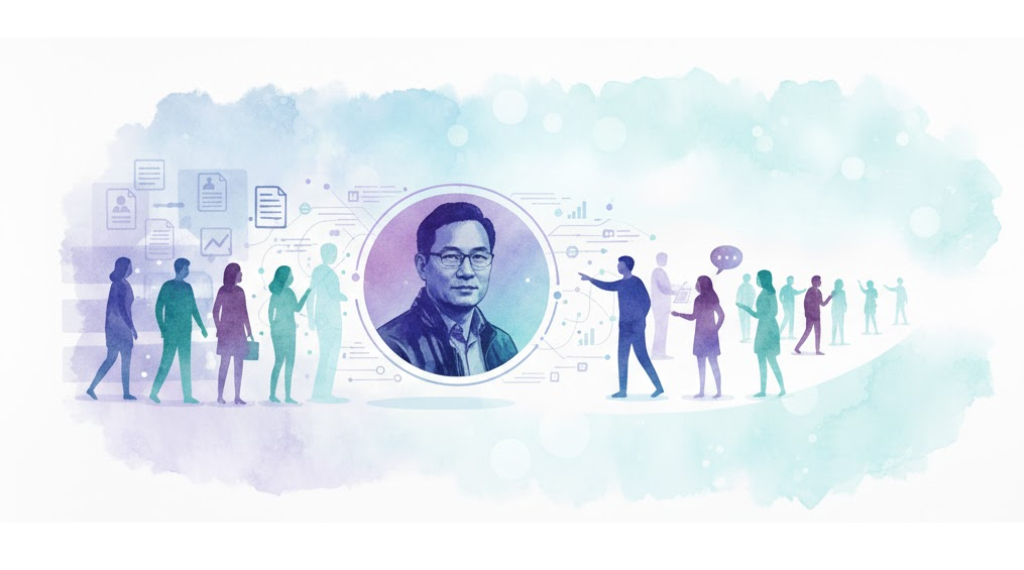

Nvidia CEO Jensen Huang has predicted that artificial intelligence agents will soon become formal employees within organisations, complete with hiring processes, onboarding and performance reviews.
Speaking at the World Economic Forum in Davos, Huang outlined a future where AI agents are integrated into company structures as “digital employees” – a shift he believes will fundamentally reshape how businesses operate.
From tools to employees
Huang explained that AI agents will move beyond being simple tools. Instead, they will function as autonomous workers capable of handling complex tasks, making decisions and collaborating with human colleagues.
“These AI agents will have employee IDs, email addresses and defined roles within teams,” Huang said. “They’ll be onboarded just like any new hire – given access to systems, trained on company processes and assigned specific responsibilities.”
According to Huang, this transformation is already underway. Companies across industries are beginning to deploy AI agents for tasks ranging from customer service to data analysis, and the technology is advancing rapidly.
The business case for AI employees
Huang highlighted several advantages of treating AI agents as formal employees:
- Accountability: Assigning clear roles and responsibilities makes it easier to track performance and outcomes
- Integration: Formal onboarding ensures AI agents understand company culture, processes and objectives
- Scalability: Organisations can rapidly expand their workforce without the traditional constraints of hiring and training human employees
- Collaboration: When AI agents have defined roles, human workers can interact with them more effectively
“The goal isn’t to replace humans,” Huang emphasised. “It’s to augment human capabilities and allow people to focus on higher-value work whilst AI handles routine or data-intensive tasks.”
Challenges ahead
Despite the potential benefits, Huang acknowledged that this shift will raise significant questions. Organisations will need to address issues such as:
- How to measure AI agent performance
- Who is responsible when an AI agent makes a mistake
- How to ensure ethical use of AI in decision-making
- What safeguards are needed to protect data and privacy
He also noted that regulatory frameworks will need to evolve to accommodate AI employees, particularly in areas like liability, data governance and workplace rights.
Industry implications
Huang’s vision reflects a broader trend in the tech industry. Companies like Microsoft, Google and OpenAI are already developing AI agents capable of performing increasingly sophisticated tasks.
For HR and business leaders, this means preparing for a future where managing a workforce includes overseeing both human and AI employees. Skills like prompt engineering, AI supervision and human–AI collaboration will become essential.
“This isn’t science fiction,” Huang concluded. “It’s happening now. The organisations that adapt quickly will have a significant competitive advantage.”
As AI continues to advance, the line between tools and employees may blur – and businesses will need to rethink everything from organisational charts to performance management systems.


