

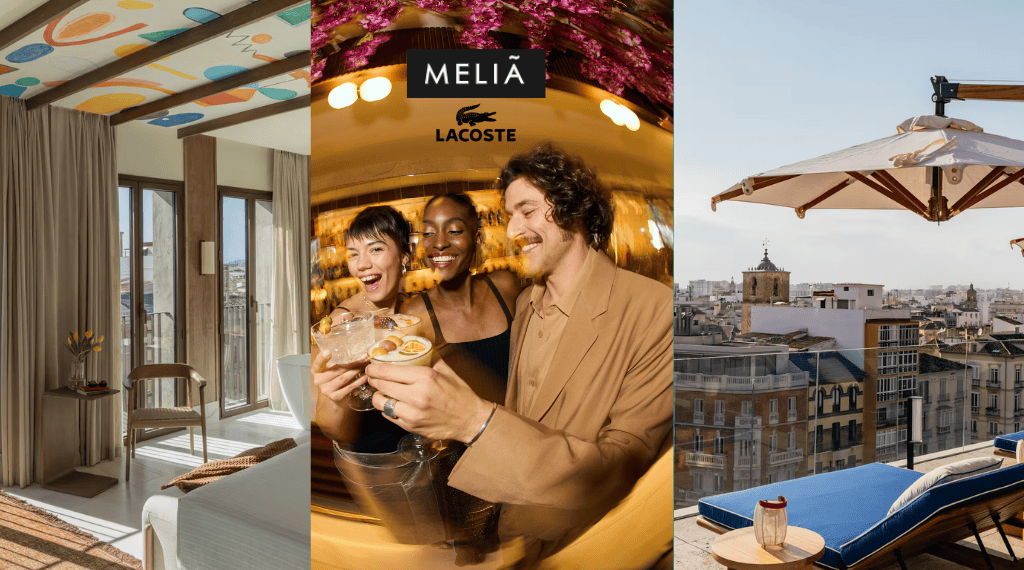

Meliá Hotels International has extended its partnership with French fashion house Lacoste to ME Málaga, the group’s newly opened five-star property in the historic heart of Andalusia’s fastest-rising city – signalling that what began as a uniform refresh is evolving into one of the hospitality industry’s more deliberate experiments in cross-sector brand identity.
The collaboration, which formally debuted at ME Marbella and ME Lisbon during the summer of 2025, sees Lacoste design and produce a curated uniform collection for the entire ME by Meliá hotel team. At ME Málaga, staff wear pieces drawn from the French label’s sport-chic aesthetic – a positioning choice that places employee presentation at the centre of the guest experience rather than at its margins.
According to the company, the collection goes beyond standard hospitality workwear. Each property receives destination-specific pieces designed to reflect the personality of its location, allowing team members to express individual style within a shared brand framework. The programme is being rolled out progressively across the wider ME by Meliá portfolio.
The workforce dimension here is deliberate. In public communications around the collaboration, Meliá has described its teams as “the main ambassadors of the brand” – language that positions frontline staff not merely as service providers but as active participants in brand storytelling. For HR leaders in luxury hospitality, this framing has tangible implications: recruitment, induction and culture-building must now align with a lifestyle aesthetic, not just service standards.
Guest-facing activations have accompanied the collaboration at other ME properties. At ME London, the Ultimate Suite ME+ was redesigned with Lacoste details and guests received invitations to the brand’s London boutique. At ME Ibiza, Lacoste staged a branded takeover of the hotel pool. Whether similar activations are planned for ME Málaga has not been confirmed publicly, but the pattern established at earlier properties suggests the Málaga team will follow a similar model.
The opening of ME Málaga itself provides a compelling backdrop for the partnership. The 128-room, eight-suite property on Calle Victoria – steps from the Plaza de la Merced and the Picasso Museum – was designed by ASAH Studio using natural materials, original artworks and abundant light to reinterpret Andalusian identity for an international luxury audience. The lobby features original works by Picasso and Miró alongside a large welcome mural by artist Marina Anaya, while designer Rafa García oversaw further interventions throughout the property.
Gastronomy provides the property’s second major draw. The rooftop hosts Cañitas Maite, the restaurant concept of chefs Javier Sanz and Juan Sahuquillo, who hold three Michelin stars across their restaurant group and were named Revelation Chefs at Madrid Fusión 2021. Their first Andalusia venture occupies the hotel’s panoramic terrace alongside a heated infinity pool and solarium. On the ground floor, lobby bar Eñe offers a more relaxed format, serving hand-held creative bites to both hotel guests and Málaga locals.
Meliá’s broader Andalusia strategy gives context to both the property and the partnership. The company now has 30 hotels open or in development across the region and 16 properties in the Málaga area. Chief executive Gabriel Escarrer stated at the opening: “The city today represents the new pulse of the Mediterranean – energy, art, and modernity – values that perfectly align with the spirit of ME by Meliá.” The pipeline reflects that conviction: Bahía Estepona member of The Meliá Collection is scheduled to open in 2026, followed by boutique Meliá Collection properties in Ronda and Cádiz.
For the industry, the Lacoste collaboration raises a question that goes beyond aesthetics. Luxury hospitality has long used interior design and gastronomy to communicate brand identity. What Meliá is testing at scale is whether staff presentation – co-created with an internationally recognised fashion brand and communicated through campaign imagery featuring real employees – can carry equivalent weight as a brand differentiator.
The answer matters most to those responsible for building and sustaining hotel teams. If the Lacoste model gains traction, it suggests that talent attraction in luxury hospitality may increasingly hinge on the proposition offered to employees, not just the experience delivered to guests.


