

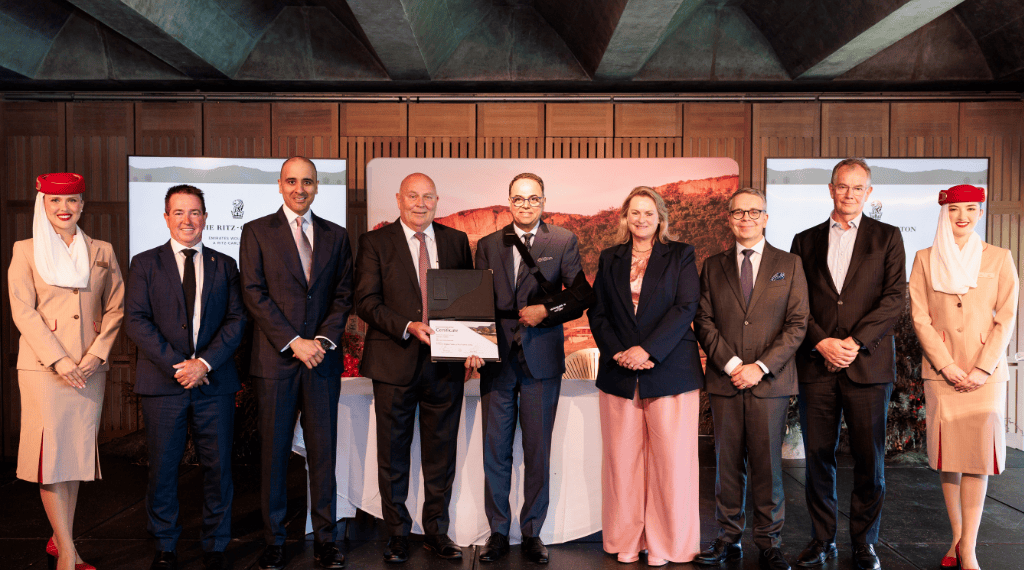

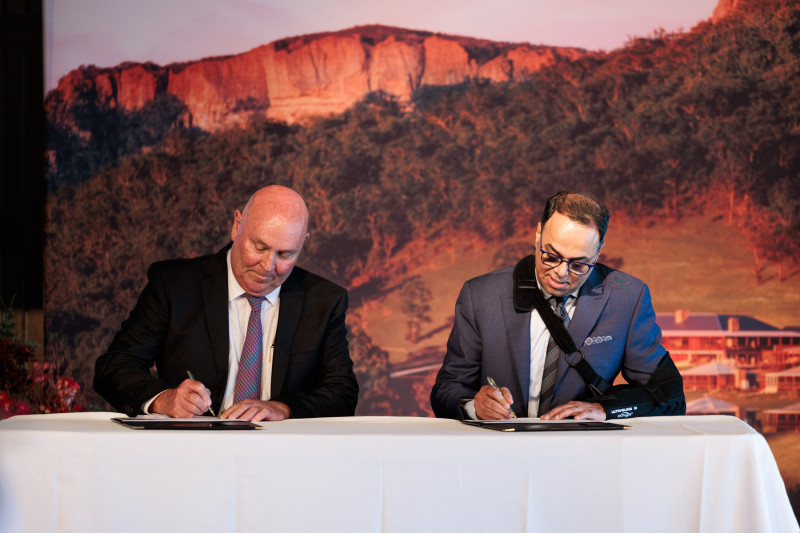
Emirates and Marriott International have signed an agreement to open the world’s first Ritz-Carlton Lodge, marking a new brand extension for the luxury hotel group and the return of one of Australia’s most celebrated wilderness properties after more than two years of closure.
Emirates Wolgan Valley, a Ritz-Carlton Lodge will open in mid-2026 as a 40-key all-inclusive resort on a 7,000-acre conservation reserve in the Greater Blue Mountains World Heritage Area. The property sits roughly three hours’ drive from Sydney within a UNESCO-listed wilderness region home to rare flora including the Wollemi pine, a species dating back to the dinosaur age.
The announcement follows a protracted period of uncertainty for the site. The property operated as Emirates One&Only Wolgan Valley until June 2023, when it closed indefinitely after a major landslip in November 2022 destroyed the only sealed access road. One&Only Resorts subsequently terminated its management contract, leaving Emirates – which has owned the site since 2006 – seeking a new operating partner.
Emirates has now invested a total of AU$200 million in the property: AU$150 million since acquiring it, plus an additional AU$50 million for renovations under the Ritz-Carlton repositioning. The partnership brings together what the companies describe as “the world’s largest hotelier and the world’s largest international airline.”
The Ritz-Carlton Lodge represents a new brand tier for Marriott, conceived as “purpose-built sanctuaries in nature, thoughtfully designed to reflect their surrounds while prioritising minimal environmental impact.” The positioning sits alongside existing Ritz-Carlton sub-brands including Ritz-Carlton Reserve and the Ritz-Carlton Yacht Collection, targeting the growing segment of high-net-worth travellers seeking immersive wilderness experiences.
“For us, Emirates Wolgan Valley, a Ritz-Carlton Lodge will not only be an extraordinary resort appealing to discerning travellers seeking to be close to nature, but also a powerful engine for local economic growth, helping to rejuvenate the Wolgan Valley locality,” said Sir Tim Clark, President of Emirates Airline.
The road access challenge that shuttered the property in 2023 will not be resolved through conventional means. Guests will access the resort either by helicopter or via a four-wheel drive route known as the Donkey Steps – a steep, unpaved track with a 32 per cent gradient. Rather than treating this as a limitation, the partners are positioning it as part of a “rural off-road experience.”
Lithgow City Council has sought AU$150 million in government funding for a permanent road solution, but construction timelines remain uncertain. The resort’s ability to operate without sealed road access represents a notable pivot – one that necessarily limits its guest profile to those willing to arrive by helicopter or rugged 4WD transfer.
Each of the 40 lodges will feature private pools and bespoke amenities. The main homestead will include an arrival lounge, signature restaurant, lounge bar and wine room. Recreational facilities comprise an outdoor pool, tennis courts, equestrian stables, fitness centre and The Ritz-Carlton Spa.
A dedicated naturalist hub, led by a resident expert, will anchor the resort’s conservation programming. Emirates has emphasised its environmental credentials at the site, including the planting of more than one million native trees and restoration of historically significant structures including an 1832 homestead where Charles Darwin reportedly stayed during his Australian travels.
“Marking the brand’s lodge debut globally, Emirates Wolgan Valley, a Ritz-Carlton Lodge will be a major drawcard for our network of 260 million loyal Marriott Bonvoy members around the world,” said Rajeev Menon, President of Asia Pacific excluding China for Marriott International. “Particularly with the upcoming plans in store for immersive experiences that connect them deeply to the local area – something our luxury travellers are increasingly prioritising.”
The integration into Marriott Bonvoy represents a significant distribution advantage, potentially funnelling the company’s vast loyalty membership base toward a property that under One&Only operated outside major hotel loyalty ecosystems. For Marriott, the lodge extends Ritz-Carlton’s Australian footprint alongside existing properties in Perth (opened 2019) and Melbourne (opened 2023).
The reopening carries considerable significance for the local community. Emirates maintained a small staff presence during the closure period, but the resort’s shuttering eliminated close to 150 jobs in the Wolgan Valley. The company has committed to re-creating these positions, alongside increased opportunities for local suppliers.
Australia’s luxury lodge sector has developed a distinctive identity centred on conservation, wildlife and immersive wilderness experiences. Operators including Saffire Freycinet, Silky Oaks Lodge and Mt Mulligan Lodge have established the segment’s positioning, typically commanding premium rates for all-inclusive stays in remote locations.
The Emirates-Marriott partnership tests whether global brand recognition can enhance this model without diluting its intimacy. At 40 keys, the property remains small by international resort standards but larger than some boutique competitors. The Ritz-Carlton name brings marketing scale and loyalty programme integration; the question is whether this strengthens or complicates the wilderness escape positioning.
Signature experiences will include a “sleep-out” offering – a guided overnight journey into remote wilderness featuring outdoor dining and campfire relaxation under what the resort describes as some of the clearest night skies in the region. Wildlife encounters with bare-nosed wombats, brush-tailed rock wallabies and native birdlife remain central to the guest experience.
The Greater Blue Mountains World Heritage Area, inscribed in 2000, encompasses more than one million hectares of eucalypt-dominated wilderness. The property itself occupies less than two per cent of its conservation reserve, with guests accessing the broader UNESCO-listed landscape through guided experiences.
For Emirates, the reopening represents a doubling-down on a two-decade investment that has survived bushfires, pandemic closures and infrastructure failure. For Marriott, it offers a proof-of-concept for a new brand extension in one of the world’s most competitive luxury lodge markets. Whether the partnership succeeds may depend on how effectively Ritz-Carlton’s service standards translate to an environment where the main competition comes not from other hotels, but from the untamed landscape itself.


