

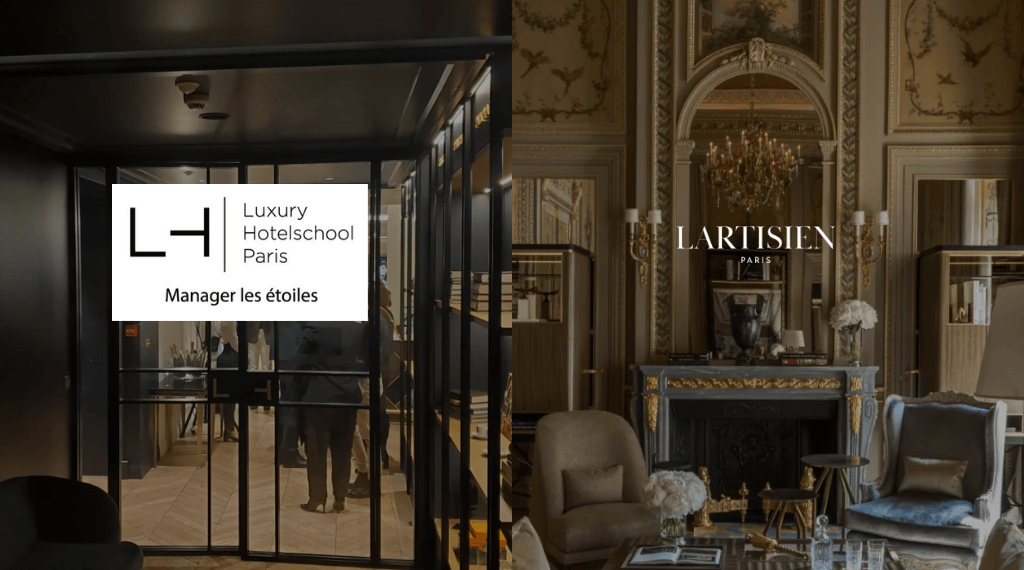

Luxury Hotel School Paris has secured a flagship sponsorship from L’Hôtel de Crillon, A Rosewood Hotel, positioning its 2026 cohort for direct access to one of Europe’s most prestigious palace hotel operations as the global hospitality sector faces projected talent deficits exceeding 40 million workers by 2035.
The partnership grants students exposure across 10 Rosewood Hotels properties in Europe, including the recently opened Rosewood Courchevel Le Jardin Alpin and four properties currently in development. The arrangement addresses a critical challenge: luxury hospitality operators are struggling to build talent pipelines capable of delivering the service standards that differentiate premium properties from
mainstream competitors.
Vincent Billiard, general director and regional vice-president of Hôtel de Crillon, signed the partnership agreement on campus in Paris, emphasising knowledge transfer and skill development for next-generation hospitality professionals. “We are honoured to sponsor the 2026 cohort,” Billiard stated. “This partnership illustrates our shared passion for hospitality and French craftsmanship. Hôtel de Crillon is committed to knowledge transmission, supporting tomorrow’s talents, and sharing a vision of luxury hospitality based on excellence, authenticity, attention to detail, and personalisation.”
The strategic timing reflects acute workforce pressures documented across luxury hospitality. The World Travel & Tourism Council warns the hospitality sector specifically will face an 8.6 million worker gap by 2035, representing 18 per cent below required staffing levels. Low-skilled roles requiring human interaction that cannot be easily automated remain in highest demand, yet luxury properties simultaneously require elevated capabilities that distinguish palace-level service from standard hotel operations.
For Rosewood Hotels, the partnership extends beyond philanthropic engagement into strategic talent development. The group operates 39 properties across 22 countries and opened eight properties in 2025 alone, including seven under the Rosewood brand. This expansion velocity demands workforce pipelines delivering service professionals who understand nuanced guest expectations, cultural sensitivity requirements, and operational precision that characterises ultra-luxury positioning.
Olivier Deveaud, general director of Luxury Hotel School Paris, positioned the partnership as essential alignment between education and industry reality. “This partnership reflects perfectly the vision of Luxury Hotel School: offering our students excellent training, anchored in the reality of luxury hospitality,” Deveaud explained. “Students have the unique opportunity to learn directly alongside exceptional professionals, to immerse themselves in the luxury universe, and to understand the standards that make our profession renowned.”
The structured approach provides students with ongoing exchanges and meetings throughout the academic year, creating sustained exposure rather than one-off placement programmes. This sustained engagement model addresses a persistent industry challenge: hospitality education programmes often fail to adequately prepare graduates for the operational demands and service philosophy requirements of palace-level operations.
Luxury Hotel School Paris operates under partnership with EHL Group (École hôtelière de Lausanne), positioning the institution within established European hospitality education networks. The school’s curriculum covers front-office operations, customer service excellence, beverage knowledge, dietetics, protocol, communication, international accounting and IT systems, alongside English language preparation for the TOEIC examination.
The Hôtel de Crillon itself represents a particularly strategic training environment. Originally commissioned by King Louis XV in 1758 and designed by Ange-Jacques Gabriel, the property opened as a hotel in 1909 and holds France’s Palace designation – the highest classification a French hotel can achieve. Operating as part of Rosewood Hotels since 2017 following an extensive restoration, the property maintains 124 accommodations including 10 signature suites, a one-Michelin-starred restaurant (L’Ecrin), and the Sense Rosewood Spa.
The partnership model signals broader strategic shifts occurring across luxury hospitality. Faced with talent shortages that constrain expansion and threaten service quality, leading hotel groups are moving beyond traditional recruitment approaches toward structured education partnerships that shape talent before candidates enter the employment market.
For HR professionals and senior leaders, several strategic implications emerge from this development pattern:
First, luxury hospitality is recognising that service excellence cannot be trained through standard onboarding programmes alone. The capabilities distinguishing palace-level operations – anticipating unstated guest preferences, managing high-net-worth client expectations, executing flawless multi-course service, navigating cultural nuances across international clientele – require deep immersion and extended development periods that education partnerships can provide more efficiently than employer-led training.
Second, the 10-property European access model demonstrates how hotel groups leverage portfolio scale to create comprehensive training environments. Students gain exposure to different property types, market contexts and operational challenges across Rosewood’s European footprint, building adaptability that single-property training cannot deliver. This portfolio-based talent development approach becomes particularly valuable as luxury groups expand aggressively into new markets requiring culturally fluent operational teams.
Third, the partnership addresses a fundamental industry paradox: luxury hospitality requires increasingly sophisticated workforce capabilities precisely when talent pools are contracting. With 65 per cent of surveyed hotels reporting staffing shortages as of early 2025 and hospitality maintaining among the highest attrition rates across major industries, operators face simultaneous challenges of attracting talent while elevating service standards that justify premium positioning.
The Rosewood expansion context heightens these pressures. The group opened Rosewood Courchevel Le Jardin Alpin in December 2025 as its inaugural alpine property, featuring 51 rooms and suites with ski-in/ski-out access at Courchevel 1850. Additional openings include properties in Greece, Italy, Saudi Arabia, United Arab Emirates and the United States, each requiring staffing with service professionals capable of delivering brand-consistent experiences across vastly different cultural and operational contexts.
This expansion velocity creates compounding talent requirements: operators need both volume (sufficient bodies to staff new properties) and capability (service professionals who understand luxury positioning nuances). Education partnerships attempt to address both dimensions simultaneously by expanding talent pipeline volume while shaping candidate capabilities during formation rather than post-hiring.
The model also reflects evolving workforce expectations among Gen Z candidates, who increasingly prioritise clear career progression pathways. LinkedIn Workforce Report data indicates 80 per cent of hospitality employees would remain with employers longer when provided transparent advancement opportunities. Education partnerships that create structured entry pathways into prestigious properties potentially address retention challenges by establishing career trajectories from training through senior operational roles.
However, challenges remain inherent in the approach. Education partnerships require sustained commitment from hotel operators who must allocate senior staff time for student engagement, provide meaningful operational exposure rather than superficial facility tours, and maintain programme consistency despite operational pressures. The partnerships work only when both parties view talent development as strategic priority rather than public relations exercise.
Additionally, the palace hotel segment represents a relatively small portion of overall hospitality employment. While Hôtel de Crillon partnerships provide exceptional training for students entering ultra-luxury operations, the broader industry faces workforce gaps across all service tiers. The skills developed for palace-level service don’t always translate efficiently to mid-market operations requiring different capability mixes, potentially creating talent development programmes that serve elite segments while mainstream operators continue struggling with chronic understaffing.
The French context adds particular strategic dimensions. France maintains strong vocational education traditions in hospitality through institutions like École hôtelière de Lausanne and various lycées hôteliers. The Luxury Hotel School Paris partnership with Hôtel de Crillon reinforces this infrastructure while positioning French luxury hospitality standards as exportable frameworks for global property operations.
Looking forward, education partnerships likely become standard components of luxury hospitality talent strategy rather than exceptional initiatives. As workforce gaps widen and expansion continues, operators lacking structured talent pipelines will face mounting disadvantages against competitors who secure early access to trained candidates through institutional relationships.
For HR executives and senior leaders, the implications extend beyond hospitality alone. The partnership model – where leading operators co-create education programmes aligned with specific operational requirements – offers potential frameworks for other sectors facing simultaneous talent shortages and capability elevation requirements. The approach potentially applies across professional services, healthcare, advanced manufacturing and other industries where specialised knowledge and cultural fit requirements create recruitment challenges that traditional hiring approaches cannot adequately address.


