

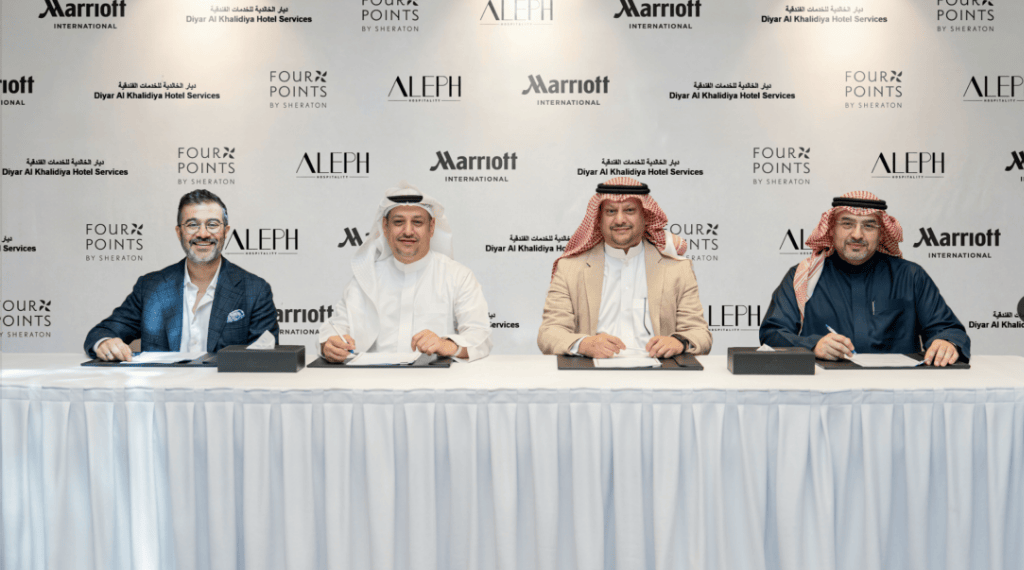

Aleph Hospitality has confirmed the formal branding of its Makkah property under the Four Points by Sheraton flag, completing an arrangement that began when the Dubai-headquartered management company took over operations of the Diyar Al Khalidiya hotel in August 2025. The announcement brings together a franchise agreement between Diyar Al Khalidiyah Hotel Services Company and Marriott International with a third-party management contract with Aleph – a structural model that is becoming increasingly common across the Kingdom as hotel owners seek international brand credentials without relinquishing asset control.
The 338-key property on Ibrahim Khalil Street sits within direct proximity of the Great Mosque of Makkah and the Abraj Al-Bait Towers, positioning it at the epicentre of one of the world’s most concentrated hospitality demand corridors. For a hotel in this location, brand affiliation is not incidental – it is a direct lever for capturing the growing share of pilgrims who seek internationally recognised accommodation standards.
The branding marks Aleph’s third Marriott-branded property under management in Saudi Arabia, and its sixth across the Middle East and Africa. The company now manages more than 50 hotels across 23 countries, representing over 7,000 rooms – a portfolio it has assembled through deliberate regional specialisation rather than global scale.
“We enjoy a longstanding and trusted relationship with Marriott International, underpinned by a shared focus on excellence and continuous improvement,” said Tariq Dowidar, Vice President Saudi Arabia at Aleph Hospitality. “Our collective ambition is to elevate the guest journey while delivering strong operational performance and value for our owners.”
The market context makes this deal strategically significant beyond the individual property. Makkah sits at the centre of Saudi Arabia’s most consequential tourism growth story. According to official projections cited in the company announcement, total Hajj and Umrah visitors are expected to rise from approximately 31.8 million in 2024 to 42.8 million by 2030 – growth underpinned by infrastructure investment, expanded pilgrimage visa access, and the Nusuk digital platform, which has streamlined the logistics of religious travel.
Vision 2030’s tourism targets have created a structural shortage of internationally branded rooms in Makkah. The city’s hospitality inventory is expanding, but demand growth is consistently outpacing supply – a dynamic that raises occupancy floors and makes branded, well-managed properties highly defensible commercial assets. Aleph’s earlier Saudi experience bears this out: its Four Points by Sheraton Jeddah King Fahd Road reportedly achieved a 59 per cent average occupancy rate in its first year of operations, according to company-cited figures.
For HR and talent professionals in the hospitality sector, Aleph’s model carries specific workforce implications. Third-party management companies operate across multiple owner-operator relationships simultaneously, which places significant demands on management depth, consistency of training, and cross-property talent mobility. Aleph has indicated a commitment to local workforce development in the Kingdom – a consideration that aligns with Vision 2030’s Saudisation targets for the hospitality sector, which require operators to actively invest in national talent pipelines.
Aleph’s Saudi expansion has accelerated considerably over the past 18 months. The company announced 11 hotels across the Kingdom at the Future Hospitality Summit in late 2025, with properties spanning Riyadh, Jeddah, Makkah, Abha and the Eastern Province. Its stated target is 20 hotels in Saudi Arabia by 2030, part of a wider ambition to reach 100 properties under management globally by 2029. The Onomo portfolio acquisition in mid-2025 – which added 26 hotels across 15 African countries – effectively doubled the company’s footprint in a single transaction.
Riyad Al Horaibi, CEO of Diyar Al Khalidiya, framed the partnership around financial discipline as much as brand appeal. “We are pleased to partner with Aleph Hospitality, a reputable and experienced hotel management company known for delivering operational efficiency and strong ROI,” he said in the company’s announcement. “With the increasing demand in Makkah’s hospitality sector, it was important for us to align with a management firm that understands the local market and brings a track record of success.”
The broader competitive picture adds further context. International hotel groups – Marriott, IHG, Hilton and Accor among them – are all actively scaling their Saudi presence, but many are doing so through franchise and management agreements with independent operators rather than direct management, given the capital intensity of the market. Aleph’s positioning as a pure management company, without the brand ownership conflicts that complicate relationships between branded chains and independent hotel owners, gives it a structural advantage in attracting franchise deals.
The Makkah property is, by any measure, an asset in the right place at the right time. As Saudi Arabia continues its push to expand religious tourism infrastructure under Vision 2030, the question for operators like Aleph is not whether demand will grow, but whether management systems and workforce capability will scale fast enough to meet it.


