‘Branded supply hasn’t caught up’: IHG’s Cameron Burke on the regional Australia opportunity
IHG Hotels & Resorts is sharpening its focus on Australia's regional and gateway cities, with two imminent 2026 openings in Townsville and Darwin anchoring a deliberate push into markets where…
 News Desk
5 min read
News Desk
5 min read
IHG Hotels & Resorts is sharpening its focus on Australia’s regional and gateway cities, with two imminent 2026 openings in Townsville and Darwin anchoring a deliberate push into markets where international branded supply has historically been limited.
The strategy is rooted in a recognisable gap. Across many regional Australian cities, occupancy and rate performance has held up well, supported by sustained investment in sectors such as mining, defence, healthcare and aviation. Yet branded hotel supply in these markets has not kept pace with the underlying demand.
‘We are seeing strong interest in markets where demand fundamentals are well established, but branded supply has not yet caught up,’ said Cameron Burke, Head of Development, Australasia & Pacific, IHG Hotels & Resorts. ‘For owners, that creates an opportunity to introduce globally recognised brands, supported by powerful distribution and a sophisticated commercial platform, into locations where they can make an immediate impact.’
Two openings anchor the push
The 93-room Holiday Inn Townsville is scheduled to open in May 2026. A conversion of the former Madison Plaza Hotel, the property sits on the corner of Stanley Street and Flinders Street in Townsville’s CBD. It is owned by Luxora Hotels and operated by La Vie Hotels and Resorts. Amenities include all-day dining, conference and events facilities, and the Holiday Inn Open Lobby concept: a flexible space designed to blend dining, social and work areas.
The location reflects the demand thesis directly. Townsville serves as a logistics and operational hub for the mining, energy and defence industries. Several events linked to the 2032 Brisbane Olympic programme are also confirmed for the city, providing a longer-term anchor for accommodation demand.
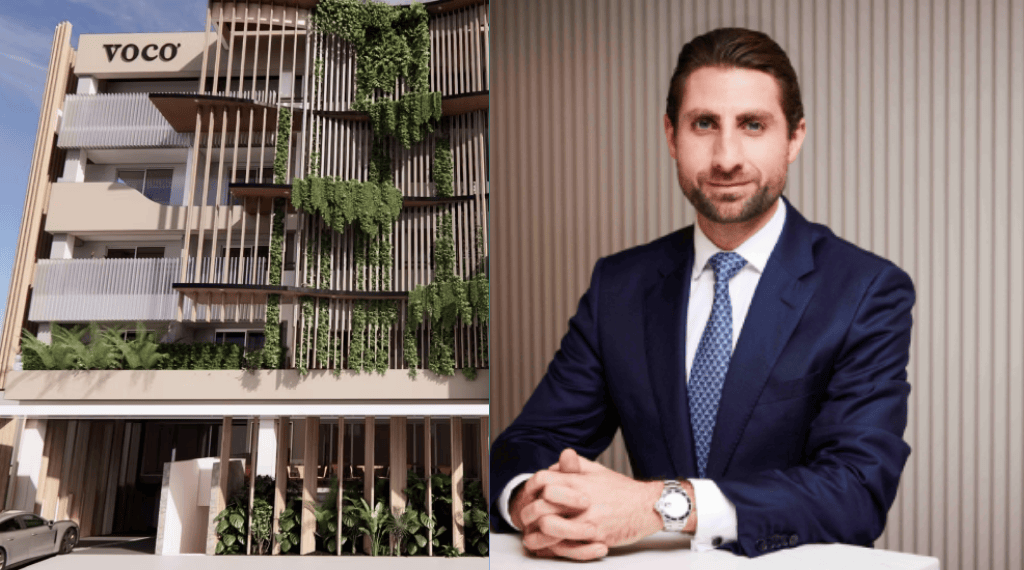
The second property, voco Darwin Suites, is due to open in June 2026. Located at 87 Mitchell Street in the heart of Darwin’s CBD, the 87-key hotel is developed by the John Halikos Group and adapted from a commercial office building. Every suite features a self-contained kitchenette, positioning the property to capture both short-stay and extended-stay demand.
The opening marks voco’s entry into the Northern Territory and returns IHG to Darwin after more than a decade of absence. Recent Tourism Research Australia data points to a 28% increase in overnight visits to the Northern Territory, strengthening the investment case for premium branded accommodation in the market.
The conversion model
Both openings share a common approach: neither involves new construction. That preference for converting and repositioning existing assets runs through IHG’s current regional strategy, and it reflects broader market conditions across Australia.
Colliers research published earlier this year found that rising construction costs contributed to new hotel supply growth of just 1.3% across Australia’s major accommodation markets in 2025. That environment makes conversion a more capital-efficient route to market than greenfield development, with lower upfront costs and faster paths to stabilised performance.
For the Townsville project, a full refurbishment preceded the Holiday Inn rebrand. The Darwin property was restructured from commercial office use. Both illustrate how existing real estate can be repositioned to carry a global brand and access the distribution, loyalty and commercial systems that accompany it.
Lean operating formats
IHG is also adapting its brand formats to suit regional market economics. The Open Lobby concept, incorporated into both its standard Holiday Inn properties and Holiday Inn Express, reduces the complexity and cost of food and beverage operations without compromising the guest experience. Smaller room footprints improve returns per square metre, and limited-service formats allow leaner staffing structures suited to markets where labour supply can be tighter.
These principles are visible across IHG’s wider Australian regional pipeline. A 170-key Holiday Inn Express is under development in Perth’s southern corridor, adjacent to the Australian Marine Complex and the Murdoch Medical Precinct, and is scheduled to open in late 2026.
A two-speed Australian programme
These regional moves form one strand of a broader Australian growth programme. IHG operates 76 hotels across Australasia under nine brands, with a pipeline of 26 further properties confirmed in mid-2025, several of which have since opened.
At the premium end, a long-term partnership with Salter Brothers is repositioning several Crowne Plaza properties under the InterContinental banner and will return Regent Hotels & Resorts to Australia for the first time in 28 years, with Regent Melbourne due to open in 2030.
The two programmes reveal a group working deliberately across multiple segments simultaneously. For its regional and mid-market activity, the underlying logic is consistent: identify markets where demand has outpaced branded supply, apply the global platform, and pursue conversion wherever possible to manage capital and time to market.
Townsville and Darwin are the current test cases. If early performance tracks as anticipated, they are unlikely to be the last.