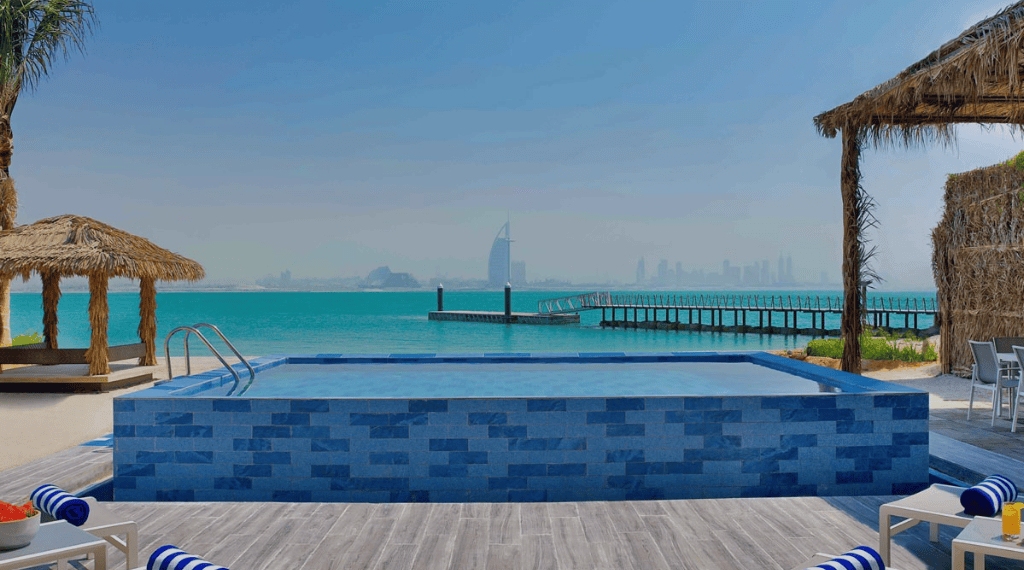
Minor Hotels has confirmed the permanent closure of Anantara World Islands Dubai Resort, ending operations at one of the emirate’s most distinctive luxury properties amid a broader regional tourism crisis that is reshaping Dubai’s hospitality landscape.
The resort ceased operations on 10 April 2026, following a joint decision between the Bangkok-headquartered operator and property owner Seven Tides Ltd. Minor Hotels described the outcome as the result of ‘a combination of external factors’ rather than any single cause, and confirmed that its immediate priority was supporting the affected workforce through the transition.
The closure brings down the curtain on a five-year chapter for a resort that opened in 2021 as the first hotel to operate on Dubai’s ambitious World Islands development.
A pioneering position, undone by complexity
Situated on the South American cluster of the World Islands, an archipelago of approximately 300 man-made islands constructed in the shape of a world map, the resort comprised 70 rooms, suites and villas. Access required guests to check in at a sister property on Palm Jumeirah before boarding a 20-minute boat transfer to the island.
That logistical model, while central to the resort’s private-island appeal, also added significant operational complexity and cost. Running a high-end property in an offshore location carries considerably higher overheads than mainland counterparts, from transport and logistics to maintenance and staffing infrastructure.
The property offered three dining outlets: Helios, a Mediterranean all-day restaurant; Luna, a Frida Kahlo-inspired South American lounge; and Qamar, a Middle Eastern and Indian venue with majlis-style seating. Room rates began at AED 1,596 per night.
The context: a sector under severe pressure
The closure does not occur in isolation. Dubai’s hospitality industry is navigating one of its sharpest downturns since the pandemic, driven by regional geopolitical pressures linked to the ongoing Iran conflict.
Hotel occupancy across the city has reportedly fallen to between 15 and 20 per cent, according to industry data cited by senior travel executives. The WTTC has projected that the Middle East could receive between 23 and 38 million fewer international visitors in 2026 than previously forecast, representing a potential loss of between $34 billion and $56 billion in regional visitor spending.
In response, Dubai announced an AED 1 billion ($272 million) financial support package for hotels and tourism operators, including the deferral of government fees, sales fees and the tourism dirham charge for three months from April 2026. Industry observers note that while the package provides short-term liquidity relief, sustained recovery depends on the restoration of traveller confidence and international flight volumes.
Destination-reliant assets face the sharpest exposure
Properties that depend on consistent destination-driven tourism flows, rather than corporate travel or transit demand, face disproportionate risk in periods of prolonged visitor decline. Anantara World Islands, by design, served an audience seeking exclusivity and island seclusion: a segment vulnerable to discretionary travel cutbacks when regional uncertainty escalates.
The closure adds to a wave of hotel suspensions across Dubai, though the nature of those shutdowns varies significantly. The Burj Al Arab has announced an 18-month closure for restoration, its first since 1999. Park Hyatt Dubai will close in May for the final phase of a long-running renovation. Armani Hotel Dubai, inside the Burj Khalifa, closed in April for a full refurbishment with reopening expected in early 2027. Radisson Blu Hotel, Dubai Media City is set to close on 30 April.
Unlike those temporary withdrawals, the Anantara World Islands closure carries no stated reopening date or renovation rationale, suggesting a permanent exit rather than a strategic pause.
Staff transition and portfolio continuity
Minor Hotels has reaffirmed its commitment to the UAE market, emphasising the continued operation of its remaining portfolio: Anantara The Palm Dubai Resort, Dukes The Palm, NH Collection Dubai The Palm and Oaks Ibn Battuta Gate Dubai. The group also operates several Anantara-branded properties across Abu Dhabi, including Qasr Al Sarab Resort and Desert Islands Resort.
The company’s statement, while brief, signalled a measured response: ‘While this is not the outcome we had hoped for, our immediate focus is on supporting our team members through this transition.’
That framing matters beyond communications strategy. A closure of this nature triggers immediate workforce displacement for a team that operated a fully integrated island resort, from food and beverage to marine operations. The speed and quality of the transition support offered to those employees will be a meaningful test of the operator’s people commitments under pressure.
Reading the wider signal
For senior leaders watching Dubai’s hospitality sector, the Anantara World Islands closure offers a pointed reminder about asset vulnerability in destination-led luxury hospitality. Properties that bet heavily on experiential uniqueness and geographic seclusion require not just a strong product, but consistent, uninterrupted access to the high-net-worth travellers they are built to serve.
When that flow is disrupted, whether by geopolitical turbulence, operational complexity or a combination of external pressures, the margin for recovery is narrower than it appears in periods of peak demand. As Dubai recalibrates its hospitality offer through 2026, the questions of which asset types prove resilient and which prove fragile are only beginning to be answered.