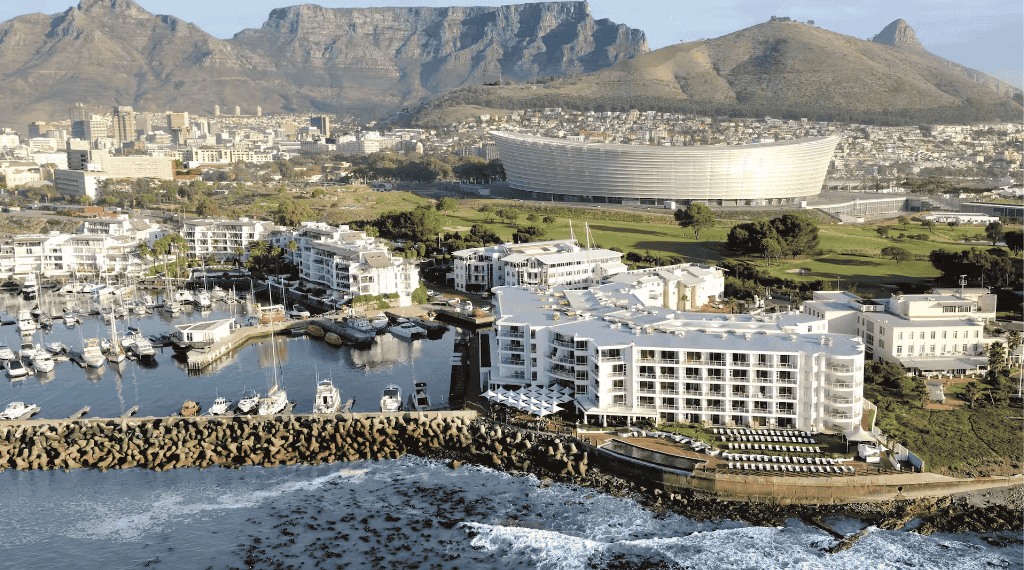
Radisson Hotel Group has surpassed 100 hotels across Africa in operation and under development, marking a significant continental milestone as the group deepens its presence in priority markets and pushes into new territories.
The announcement, made at the Future Hospitality Summit Africa in Nairobi, reflects a period of accelerated activity. Over the past 12 months, the group signed more than 15 hotels and around 2,500 rooms, including first-time market entries in the Democratic Republic of Congo and Zimbabwe.
Conversion as competitive advantage
Central to Radisson’s Africa strategy is a conversion-led growth model that trades ground-up timelines for faster market entry. Over the past five years, more than 15 hotels representing close to 3,000 rooms joined the Radisson Africa portfolio through conversions alone – a pace that has allowed the group to lead openings across the continent while compressing the gap between signing and operational launch.
Ramsay Rankoussi, Regional Chief Development Officer, commented: “We’ve crossed the 100-hotel mark in Africa by staying true to our plan, focusing on where we can lead, moving fast on quality conversions, and partnering with owners who share our ambition. Our pipeline is built to open, not just to announce.”
The distinction matters in a market where project delays are common. Both Radisson and Radisson Blu have ranked among the most frequently signed hotel brands in Africa over the past five years, with a notably high share of actual openings relative to announcements.
Brand architecture: dual-speed growth
Radisson Blu continues to anchor the group’s legacy footprint, while the Radisson brand is currently its fastest riser, supported by a strong conversion engine and a pipeline that is consistently translating into openings.
With a presence in more than 30 African countries, the group blends depth in focus markets with selective entry into new destinations each year. That breadth of distribution has positioned Radisson as one of the continent’s most geographically diverse operators – a factor increasingly relevant to corporate travel buyers and global account management.
Priority markets: Morocco, Nigeria, South Africa
Nigeria remains one of the group’s most active markets. The group now holds 13 hotels in operation and pipeline, with Abuja carrying an active development pipeline of three properties totalling 458 keys. Beyond the capital, new signings in Aba and Yenagoa reflect a deliberate push into secondary cities, while a Radisson Collection property planned for Victoria Island in Lagos targets the upper segment of the city’s corporate and leisure market.
In Morocco, the group is advancing multiple projects across Casablanca, Rabat and Marrakech. Recent signings include the Radisson Blu Resort & Conference Center Bouskoura, the first Radisson brand hotel in Rabat, and further expansion in Marrakech – a direct response to the country’s growing positioning as both a MICE and leisure destination.
South Africa’s strategy focuses on Cape Town, targeted growth in secondary cities such as Durban and Pretoria, and a sharper focus on leisure corridors including Kruger National Park, Sun City and the Garden Route.
New frontiers: nature-led and resort hospitality
The group’s next growth chapter points firmly towards resort and nature-based hospitality. Plans are underway for entry into Zanzibar, while opportunities are being explored across Namibia, Botswana and Zambia, particularly in the lodge and safari segment.
In Zimbabwe, the pipeline includes serviced apartments in Harare and a Park Inn by Radisson resort near Victoria Falls, expected to open in 2029. Located five kilometres from the falls, the 150-room property will sit near one of the Seven Natural Wonders of the World, which attracts more than 350,000 international visitors annually.
In Egypt, a 469-room resort development at Ain Sokhna on the Red Sea and serviced apartments in Sheikh Zayed City are slated to open in 2029 and 2030 respectively, targeting leisure and extended-stay demand.
Radisson within a broader continental surge
Radisson’s milestone arrives against a backdrop of record-level hotel investment across Africa. According to W Hospitality Group’s latest Hotel Chain Development Pipelines in Africa report, the continent’s development pipeline has reached an all-time high of 123,846 rooms across 675 hotels and resorts planned for 2026 – an 18.6% year-on-year increase. Africa also recorded an 8% rise in international tourist arrivals in 2025, the strongest growth rate globally according to UN Tourism, with the continent welcoming around 81 million international visitors last year.
Radisson is among the five global chains – alongside Marriott, Hilton, Accor and IHG – that collectively account for around 80% of all pipeline hotels and rooms across Africa. Within that cohort, Marriott leads by pipeline volume; Radisson’s differentiator is speed, deploying conversions to compress the time between signing and opening.
The risk facing all operators, including Radisson, is execution. Historical delivery rates across Africa suggest actual openings frequently fall short of projections, reflecting persistent challenges in financing, construction and regulatory processes. The group’s conversion-heavy model is partly a hedge against that structural constraint.
With its 100-hotel mark now confirmed, the group’s stated next phase is one of concentrated market depth rather than broad-brush geographic expansion. The credibility of that ambition will be tested, as it always is in Africa, by how many of those pipeline properties actually open – and on time.