
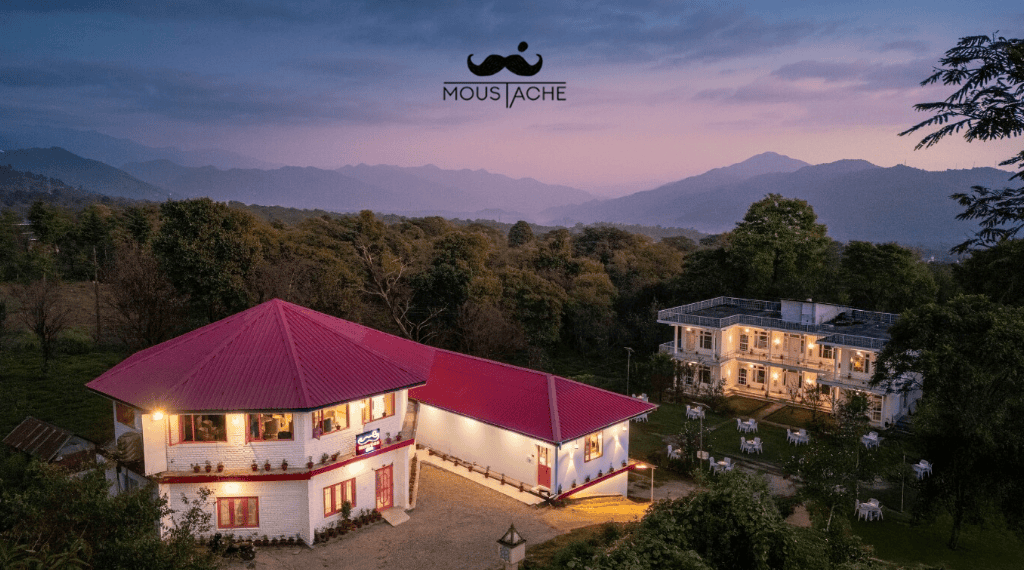
When Abhishek Khandelwal and Deepak Agarwal launched Moustache in 2015, the Indian backpacker market had no credible organised player. A decade later, that gap has been filled – and the company that filled it has quietly moved well beyond it.
Founded in 2015 by Abhishek Khandelwal and Deepak Agarwal, Moustache began as a community-first hostel concept for budget travellers – the kind of operation that attracts strong guest loyalty and very little institutional attention. Khandelwal brought over 23 years of international financial services experience across Canada, the US and Oman, having worked with KPMG, Moore Stephens and Cedar Fair Entertainment. Agarwal arrived from consulting and advisory roles at Deloitte, NCR Corporation and Frigoglass, with operations experience spanning more than 35 countries. Two accountants building hostels was, by any conventional logic, an odd proposition.
It turned out to be a structural advantage. The founders understood unit economics, destination selection and capital discipline in ways that pure hospitality operators often do not.
Building the base
Over the past decade, more than 1.5 million travellers have stayed at Moustache properties. The group now operates more than 33 properties across 11 states – a footprint built largely without significant institutional capital, spanning Rajasthan’s heritage cities, Himalayan adventure corridors, coastal Goa and the Gangetic plains, with properties in destinations including Jaipur, Udaipur, Rishikesh, Manali, Varanasi and Khajuraho.
The hostel model worked because it tracked where Indian domestic travel was actually going, rather than where legacy operators assumed it would go. The Indian hostel and backpacker market was estimated at INR 1,413 crore in 2024, driven largely by millennials, Gen Z and solo travellers. Moustache had been serving that demand before most of the sector acknowledged it existed.
The rebrand question
By 2025, the business had a perception problem that success had created rather than solved. Many travellers continued to view Moustache as a hostel-only operator, despite the company having built mid-market and boutique luxury properties alongside its hostel portfolio. The gap between what the brand communicated and what the business actually was had become commercially limiting.
The 2025 rebrand addressed this directly. The refreshed architecture defines three verticals: Moustache Hostels, which remains social and community-driven; Moustache Select, focused on comfort-first mid-market stays for families and professionals; and Luxuria by Moustache, targeting boutique and experiential luxury. According to a company press release, AVP – Marketing Aditya Singh Ranawat summarised the challenge plainly: “We had evolved beyond hostels, but people still saw us as just a hostel brand. The rebrand closes that gap.”
Where the growth is going
The commercial logic of the three-vertical structure is clear in the revenue projections. According to Hotelier India, Deepak Agarwal has stated that the Select segment alone is expected to contribute 40 to 50 per cent of the company’s projected INR 100 crore revenue by 2026. Five Select properties are currently operational, in destinations including Naukuchiatal, Mukteshwar and Udaipur.
The November 2025 launch of a 49-key Select property in Manali signalled the pace of that buildout. Khandelwal described Manali as one of India’s strongest mid-range hotel markets, citing over 15,000 tourists per day and a year-round inflow that makes it well-suited for the Select format.
Meanwhile, the hostel vertical is pushing into geography rather than density. The December 2025 entry into Gangtok, Sikkim, marked Moustache’s formal arrival in the Northeast – a region that recorded 12.781 million domestic tourist visits and 0.244 million foreign arrivals in 2024, according to HVS ANAROCK, with air traffic reaching a record 11.2 million passengers. Upcoming hostel properties are planned across Himachal Pradesh, Uttarakhand, Kerala, Tamil Nadu and Karnataka.
The pipeline
The company plans to add up to 50 new properties by 2028, with a strong focus on mid-market and boutique luxury formats. According to Tracxn, employee headcount grew 230 per cent year-on-year between July 2024 and July 2025 – a signal that operational infrastructure is being built to match the ambition.
Whether Moustache can execute a 50-property expansion while maintaining the experiential quality that built its reputation is the open question. The rebrand answers the perception problem. The pipeline answers the growth question. The harder test – delivering consistency across three segments, 11 states and an aggressive opening calendar – is the one still being written.