
A Victorian working farm, a coastal NSW retreat and a historic Palm Cove resort have claimed the top honours in the five-star luxury accommodation category at the 2025 Qantas Australian Tourism Awards – and their stories say as much about where Australian luxury hospitality is heading as they do about the properties themselves.
The awards ceremony was held at Fremantle Prison in Western Australia, with more than 170 finalists competing across 26 categories before an audience of over 800 industry representatives. Now in its fifth decade, the programme has long been regarded as Australia’s most rigorous national benchmark for tourism excellence.
A working station earns the gold
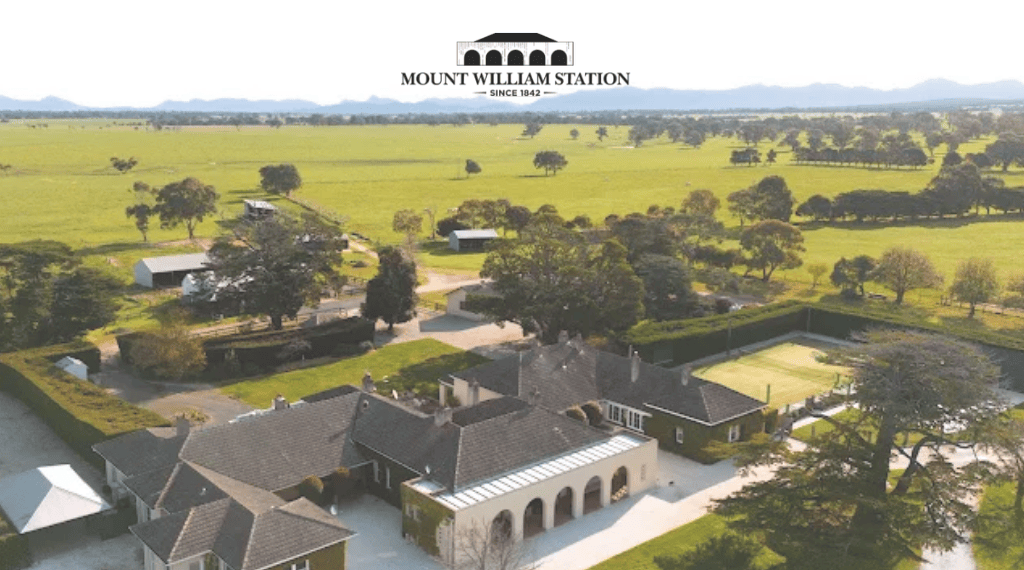
Australia’s Best Luxury Accommodation gold went to the family-run Mount William Station, situated at the foothills of the Grampians National Park in Victoria.
Founded in 1842 as one of Australia’s earliest pastoral holdings, the 7,500-acre estate was purchased by the Barr Smith family in 1919. Fourth-generation owner Will Abbott, who previously pursued a career in investment banking and property management in Shanghai, returned to restore the ageing homestead and open it to guests for the first time.
The 1920s homestead – featuring Art Deco cornicework, Jarrah floors and Spanish Colonial Revival arches – has been converted into a boutique hotel with seven ensuite bedrooms, alongside a Shearers’ Quarters that accommodates a further 18 guests. The estate still operates as a working stud and lambing farm, with Abbott’s siblings running cattle and sheep operations on adjacent land.
Abbott says the recognition reflects the collective effort behind the transformation: ‘Mount William Station is a working farm that we’ve carefully evolved into a luxury lodge experience, and everyone involved has poured enormous effort into creating something special.’ The property delivers a nightly three-course communal dining experience, drawing on seasonal produce from the estate and regional Victorian growers.
A recent renovation converted the historic Bluestone Stables into a dedicated events space, and the estate has plans to further expand its accommodation offering. With bookings reportedly strong and an annual polo tournament already established on the calendar, the commercial momentum behind the heritage conversion is evident.
The broader pattern these awards reveal
What unites the top three finishers is not scale or brand recognition – it is the calibre of the experience and the clarity of a distinct hospitality identity. All three are independent, owner-operated properties. None carries a global flag. That is not coincidental.
High-spending leisure travellers – particularly in the post-pandemic era – have increasingly sought out places where provenance is real and the story is genuine. Large branded hotels compete on consistency and loyalty programmes. Independent properties like Mount William Station compete on irreplaceability.
For HR and workforce leaders in hospitality, this dynamic has tangible consequences. Operator-run luxury properties depend heavily on small, highly skilled teams who can deliver personalised, high-touch service without the operational scaffolding of a large corporate. Recruiting and retaining those people in regional and remote locations is one of the industry’s most persistent challenges.
Silver: a quiet operation making noise nationally
Silver was awarded to Mt Hay Retreat in Berry on the NSW South Coast, set on 145 hectares of farmland and native bush. Operators Anthony and Louise described the recognition as both validating and disorienting for a small rural business accustomed to working quietly.
Their comments are particularly notable for a hospitality audience. Reflecting on the accelerating pace of technology and AI adoption in the industry, they noted: ‘We pride ourselves on being a bit of an antidote to modern living – offering guests real, professional, warm hospitality and an opportunity to take a breath.’ The property is simultaneously adopting targeted technology – including a robotic lawnmower to reduce fuel use – demonstrating that operational efficiency and analogue hospitality are not mutually exclusive.
Bronze: a Palm Cove institution holds its ground
The Reef House Adults Retreat in Palm Cove, Queensland, claimed bronze. One of the first properties built in Palm Cove in 1958, the adults-only beachfront resort sits between the Great Barrier Reef and the Daintree Rainforest and is a consistent multi-award-winner across both its restaurant and accommodation categories.
Its continued presence in the national rankings – as a heritage property in a destination increasingly crowded with newer competitors – reflects how sustained service standards and a clear market position can outlast the novelty cycle that routinely inflates and deflates property reputations.
What this means for the sector
Qantas Domestic CEO Markus Svensson noted at the ceremony that Australia’s tourism operators play a key role in promoting the country’s regions, and this year’s luxury category winners illustrate exactly that. The Grampians, the NSW South Coast and Far North Queensland are not traditional luxury tourism corridors in the way Sydney’s CBD or the Whitsundays are – yet all three winning properties have built nationally recognised operations in those locations.
For senior leaders across hospitality and travel, the 2025 results carry a consistent strategic message: authenticity at scale is harder to build than amenity at scale, and when it is built successfully, it is also harder to replicate.