
Nearly five decades after establishing the benchmark for Asian luxury hospitality, Regent Hotels & Resorts is executing a deliberate brand revival that positions it in a precise competitive slot between two of the industry’s most recognised ultra-luxury names.
In a recent conversation with industry publication LATTE, Nicolas Laufrais, Director of Sales & Marketing at Regent Bali Canggu, articulated the brand’s strategic compass. According to Laufrais, Regent should sit “between Peninsula and Rosewood – not as classic as Peninsula, but not as modern or design-driven as Rosewood.” It is a positioning statement that signals intent as much as identity.
The brand’s origin story is well documented. Founded in 1970 by Robert Burns, Regent quickly became, in Laufrais’s words, “the reference of luxury back then.” What followed were decades of ownership turbulence – multiple brand changes, diluted identity, and a gradual retreat from the upper echelons of the market. The inflection point arrived in 2018, when IHG Hotels & Resorts acquired the brand and committed to a structured resurrection.
“Now the ambition of the group is really to rejuvenate the brand to what it was back in the 70s in terms of positioning,” Laufrais said.
That ambition is being expressed through selective growth rather than rapid scaling. Regent currently operates 11 properties across nine countries, encompassing 3,168 rooms. A further 11 are in the pipeline, with confirmed arrivals in Jeddah, Kuala Lumpur, Kyoto, Sanya, Shenzhen and Riyadh. According to IHG, the brand is targeting a portfolio of 40 hotels – a controlled trajectory that stands in deliberate contrast to the aggressive expansion strategies of larger hospitality groups.
As an “iconic” name, Laufrais explained, the company is “very careful about which hotels are picked up to, of course, develop.” In luxury hospitality, where brand perception is currency, selectivity is strategy.
The past three years have tested that framework. High-profile openings in Hong Kong, Santa Monica, and Shanghai – including the landmark return to the United States after more than three decades – have established Regent’s modern credentials. Regent Santa Monica Beach, which opened in October 2024, received a Michelin Key in its first year of operation.
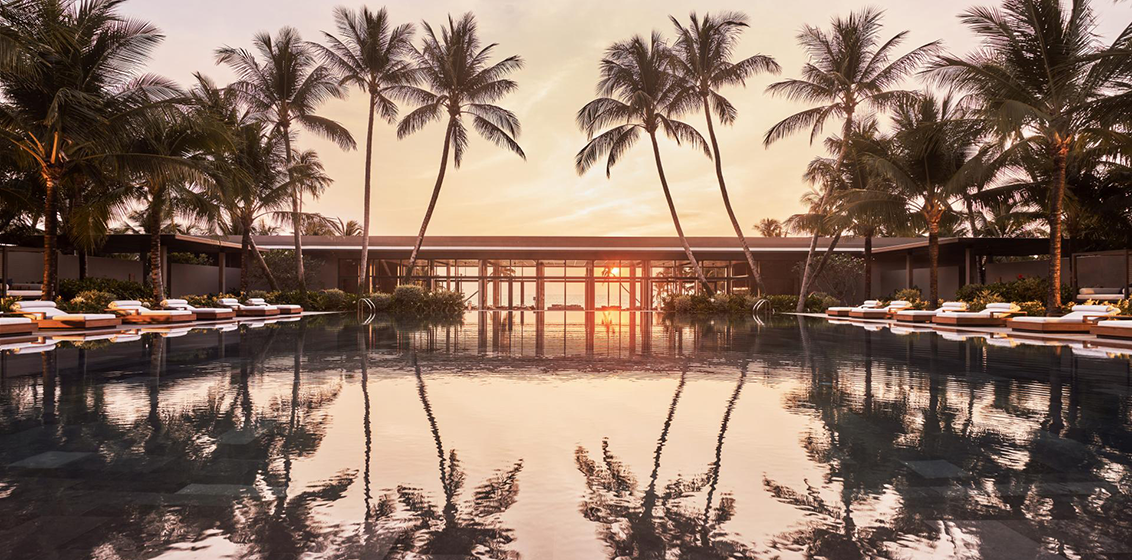
The most recent opening, Regent Bali Canggu, offers the clearest window into how IHG is translating brand positioning into built form. Designed by WATG Architects with interiors by Hirsch Bedner Associates, the 150-room resort on Canggu’s southwestern coast embedded a codified design principle: 50% of base materials are neutral and organic, 40% introduce contrast, and the remaining 10% offer, as Laufrais put it, “a touch of stimulation.” The framework ensures portfolio-wide consistency while giving each property room to express local identity.
“We are Regent, but we are also in Bali,” Laufrais said – a phrase that neatly captures the brand’s philosophy of rootedness within a global framework. Teak, andesite stone and celadon tones referencing Bali’s coastal rice fields run through the property, alongside commissioned artwork inspired by Balinese mythology. The result is a property that reads as unmistakably of its place while meeting the service and design expectations of an international luxury audience.
Service architecture is equally considered. Each Regent Bali Canggu guest is assigned a dedicated Regent Experience Agent – a single point of contact managing everything from check-in and reservations to surf lesson bookings and private helicopter arrivals. The model represents a meaningful workforce design choice: rather than distributing service responsibility across multiple departments, Regent has concentrated it in a relationship-based role. For HR leaders in the luxury segment, this raises important questions about recruitment profiles, training investment and staff-to-guest ratios at scale.
Regent Bali Canggu also debuted the world’s first Regent Spa, developed in partnership with IHG’s in-house wellness consultancy Raison d’Etre. The concept is designed for rollout across the broader portfolio, with Regent Jeddah Corniche and Regent Kuala Lumpur confirmed to follow. Introducing a proprietary spa concept at this stage of the brand’s revival carries operational weight: it demands specialist wellness talent and training infrastructure across markets with very different labour dynamics.
The competitive terrain Regent is navigating is unforgiving. Peninsula and Rosewood – the two brands cited explicitly as its nearest reference points – are themselves expanding, with Peninsula’s 2024 London opening and Rosewood’s continued push into emerging markets keeping pressure on the tier. For Regent to sustain its stated middle ground, consistent delivery of the experience promise across geographies as diverse as Saudi Arabia, Japan and French Polynesia will be the real test.
IHG’s bet is that heritage, carefully managed growth and a codified identity will be sufficient to distinguish Regent from both its reference competitors and the broader crowd of brands jostling for the upper-luxury traveller. The pipeline suggests confidence. Whether the talent infrastructure can match the architectural ambition as the brand scales will be the question luxury hospitality’s senior leaders should be tracking closely.