
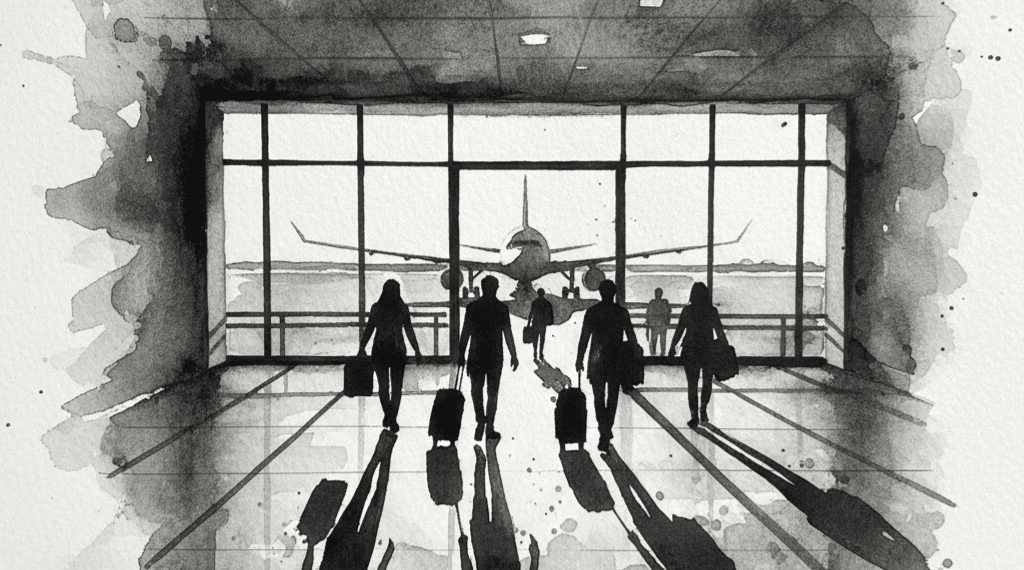
The silence after a well-made argument tells you something has shifted. No screen can carry it. No video call transmits the handshake that follows, the eye contact that seals it, the fake smiles, the real embraces, the rustle of sharp suits, the crack of luggage wheels echoing through airport corridors. All of this, it turns out, was worth the trouble. We now have the data to prove it.
For four years, the technology sector offered one with unusual conviction: that the business trip – with its cramped flights, its overpriced hotel bars, its dinners that stretched past midnight – had finally met its obsolescence. Video conferencing would do what video conferencing had always promised to do. The pandemic merely accelerated the inevitable.
It was a tidy thesis. It was also, as the latest data makes abundantly clear, almost entirely wrong.
What the numbers actually reveal
Navan’s Q4 2025 Business Travel Benchmark delivers a verdict that should give pause to anyone who built strategy around the death of corporate travel. Business travel grew 13.8 per cent in the final quarter of last year. General air travel managed 1.2 per cent. The disparity is not subtle, and it is not ambiguous.
More telling still is the relationship between volume and expenditure. Domestic business travel rose 7.9 per cent year-over-year – respectable growth by any measure. But spending increased by 17.8 per cent. The arithmetic here deserves attention: companies are not merely sending more people to more places. They are investing considerably more in each journey they authorise.
This pattern does not describe an industry reverting to old habits. It describes one that has made a calculation and is acting accordingly.
Teams develop trust through proximity that Slack channels, however thoughtfully organised, cannot manufacture.
The spending tells the story
Drill into the spending categories and a more textured picture emerges. Team events and meals – the dinners, the offsites, the gatherings that exist primarily to put colleagues in the same room – accelerated from 2.7 per cent quarterly growth in Q3 to 4.6 per cent in Q4. Client entertainment, which had been contracting modestly at 0.8 per cent, swung to a 2.7 per cent increase.
Ground transportation tells its own story. Spending on taxis, rideshares, and public transit rose over 20 per cent. Travellers are not flying somewhere to remain stationary. They are moving through cities, meeting in multiple locations, conducting the kind of peripatetic business that cannot be replicated through calendar invites.
The sectors driving this resurgence merit examination. Government and public sector travel grew 36.1 per cent – a figure that reflects, perhaps, the particular inadequacy of video conferencing for the work of bureaucracy and diplomacy. Hospitality and travel increased 33.3 per cent, an industry investing in the very product it sells. Energy and utilities rose 21.2 per cent, suggesting that the infrastructure of modern life still requires human presence to maintain and expand.
These are not industries given to sentimentality about expense accounts. When they spend, they have generally done the mathematics first.
The divergence no one discusses
What the Navan report documents but does not explicitly state is that a sorting has already occurred. Some organisations recognised, perhaps as early as 2022, that remote work’s efficiencies came bundled with remote work’s limitations – and began reinvesting in strategic travel whilst their competitors were still congratulating themselves on reduced T&E budgets.
That gap is no longer philosophical. It is competitive, and it is widening.
The mechanisms by which in-person contact creates value are neither mysterious nor particularly new. Negotiations conclude differently when parties can read body language and share meals. Teams develop loyalties through proximity that Slack channels, however thoughtfully organised, cannot manufacture. Client relationships deepen across hotel bars in ways that scheduled video calls, with their rigid time-boxes and their mute buttons, structurally prevent.
The companies that optimised for asynchronous communication whilst neglecting the synchronous kind may now find themselves playing catch-up – not because their remote work failed on its own terms, but because they mistook a cost-cutting measure for a strategic advantage.
What hospitality executives should understand
For those who operate hotels, the implications extend well beyond occupancy forecasts. This data describes a fundamental recalibration in how corporations value physical presence – and, by extension, the spaces that facilitate it.
The 17.8 per cent increase in per-trip spending signals that companies authorising travel are not hunting for economy options. They want properties that amplify the purpose of the journey: flexible spaces that accommodate both formal meetings and informal conversation, food and beverage programmes worth building an evening around, connectivity that supports the work travellers inevitably bring with them.
Hotels that positioned themselves for a future in which business travel was a declining commodity may need to revisit their assumptions. Those that invested in the infrastructure of human gathering – the meeting rooms that actually function, the restaurants where deals get made, the bars where relationships form – may find themselves disproportionately rewarded.
The market, as it tends to do, has reached its own conclusions. The remaining question for hospitality executives is straightforward enough: whether to position for this reality, or to wait for competitors who already have.
A correction, not a restoration
It would be a mistake to interpret this trend as simple nostalgia, a return to 2019 dressed in new data. What is emerging is more disciplined than what preceded it. Companies are travelling with greater intentionality, measuring returns with greater rigour, and spending with greater purpose.
The video-conferencing-will-replace-travel thesis was never quite analysis. It was hope – the kind of hope that lets finance departments cut budgets whilst feeling progressive rather than merely cheap. That hope has now collided with four years of evidence about what screens can and cannot accomplish.
The luggage wheels are rolling again. The suits are ironed. The conference rooms are booked. The market has remembered what the spreadsheet forgot – that some things only happen in person.