An inclusive uniform review for hotel teams
Uniforms and everyday equipment affect how hotel colleagues work. Use a structured review to identify avoidable barriers before renewing a supplier contract or rolling out a new range.
 Team WINC Wire
6 min read
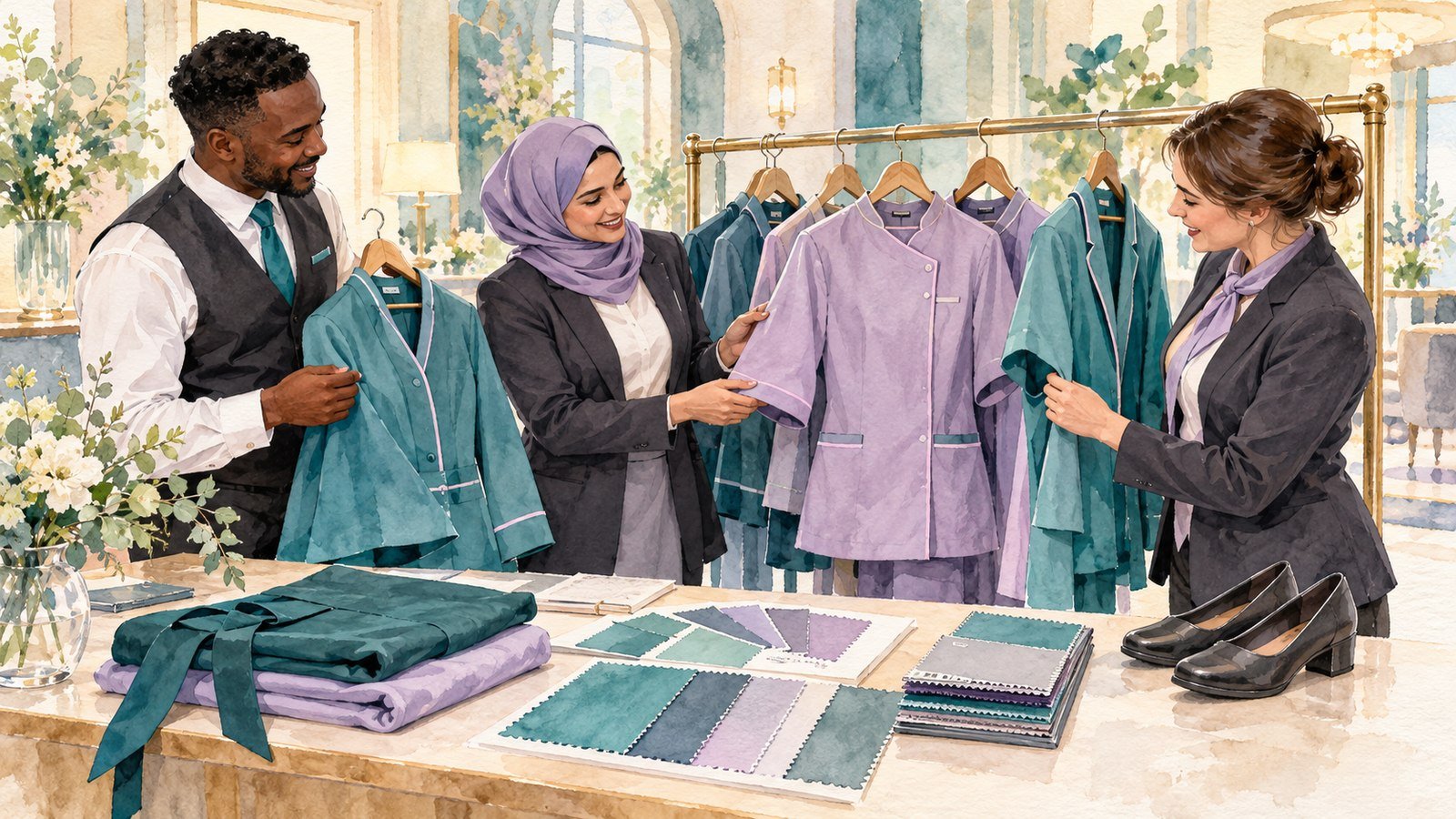
A uniform can look consistent in a supplier’s catalogue and work very differently across a hotel. A jacket restricts reach at reception. Trousers fit while standing but pull when making beds. A shared device is difficult to grip, and the only available protective gloves are too large.
An inclusive hotel uniform review tests what staff wear and use against real tasks. It brings operational requirements, employee experience and competent safety advice into the same decision, without treating appearance as the only specification.
Separate ordinary uniform from protective equipment
Start by classifying each item. An ordinary shirt primarily identifies the team or meets presentation requirements. Protective equipment is selected to control a specific risk. Some clothing can serve both purposes, so classification needs more than a purchasing label.
Ask the safety lead to identify which items form part of a risk-control system. Do not substitute a preferred fabric or alter protective clothing because it seems more comfortable. The Health and Safety Executive advises considering PPE size, fit, weight and compatibility, and warns that modifying PPE to fit is not a suitable solution.
Where suitable PPE is required, the employer must provide it free of charge in the Great Britain context described by HSE. Ordinary uniform costs raise different contractual and pay questions, so do not assume the same rule answers every clothing issue.
Agree the review’s purpose and ownership
Choose a manageable scope: one uniform renewal, a department’s equipment range or a recurring fit problem. Name an operational owner, a procurement contact, HR and a competent safety adviser. Involve employee representatives where appropriate.
Write down the requirements before comparing samples. They may include safe movement, appropriate hygiene, durability, laundering, recognisable presentation and access to suitable replacements. Separate essentials from preferences, and ask what evidence supports each restriction.
This is one practical expression of the people-led workplace approach. The review should produce decisions about actual items and processes, rather than a general statement that the hotel values inclusion.
Consult the people who wear and use the items
Invite staff from different departments, working patterns and job tasks. Do not rely solely on a daytime head-office fitting session. Include colleagues who have previously struggled to obtain a suitable size, while avoiding pressure to disclose personal information publicly.
Ask practical questions: Which movements are restricted? What happens after several hours? Can the item be adjusted as intended? Is replacement straightforward? Does the fabric, fastening or device create avoidable difficulty?
Offer a private route for disability-related needs, religious requirements and other sensitive concerns. Record an operational requirement in the general review, such as “alternative fastening needed”, rather than circulating a colleague’s diagnosis. Keep individual arrangements in the appropriate confidential process.
Run a realistic fit and movement trial
A mirror check is insufficient. Test ordinary uniform samples during representative, safe tasks with the employee’s agreement. Include reaching, bending, sitting, moving between temperature zones and carrying appropriate work items. Use supervision where the task requires it.
Check the whole combination. Aprons, jackets, head coverings, footwear and pockets may interact. A comfortable garment can become restrictive when layered. Assess practical access to radios, keys and devices without creating snagging or hygiene risks.
For non-protective equipment, test grip, reach, screen readability, button operation and storage. A shared tablet stand or adjustable workstation may be more useful than expecting everyone to adapt to one fixed arrangement. Any proposed change to safety-related equipment needs competent review.
- Fit: Suitable size and shape without improvised alterations to protective items.
- Movement: Ability to perform relevant tasks safely and comfortably.
- Comfort: Temperature, seams, labels and other reported sensory issues.
- Function: Fastenings, pockets and equipment controls work for the task.
- Care: Laundering and maintenance instructions are practical and understood.
- Availability: Suitable replacements can be obtained without prolonged workarounds.
Review restrictions with HR and safety specialists
In Great Britain, dress-code decisions must account for discrimination law. Government guidance warns against unequal or prescriptive requirements that disadvantage women, including certain footwear and appearance rules. It recommends employee consultation when developing dress codes.
Acas advises flexibility for religious needs, with restrictions justified by a legitimate aim and no more discriminatory than necessary. Disability-related reasonable adjustments may also be required. Northern Ireland has a separate legal framework; obtain appropriate advice for individual disputes or significant policy changes.
Operationally, ask whether the same presentation objective can be met through a choice of approved garments. Consider different cuts, lengths and fastening options without attaching assumptions about identity or competence. Avoid making an employee negotiate every small variation with a different supervisor.
Do not let a supplier’s size range define the policy
Ask suppliers for actual measurements, available alternatives, sample access and replacement lead times. A nominal size label is not evidence that an item fits a particular person. Check whether all approved options have comparable quality and availability.
Include arrangements for repairs, exchanges and changing needs. A colleague should know whom to contact when a uniform stops fitting or equipment becomes unsuitable. Plan how an interim arrangement will be approved without compromising safety or leaving the person visibly singled out.
WINC Wire’s discussion of neurodiversity at work provides wider context for individual differences. In this review, listen to the reported barrier rather than expecting every person with the same diagnosis to prefer the same fabric or equipment.
Hypothetical example: a housekeeping uniform renewal
A fictional hotel trials two ordinary tunic designs. The preferred catalogue design looks tidy, but several colleagues report restricted reach when making beds. Another design has the same approved colour and presentation standard with a more practical cut.
The team tests it during representative tasks and checks laundering performance before purchase. Separately, a glove-size concern goes to the safety lead and supplier for suitable protective options. The hotel does not alter the gloves or treat the uniform trial as proof that the PPE is safe.
Procurement records the selected garment, available sizes and exchange route. HR handles an individual adjustment privately. Staff receive the revised ordering process and know how to report a problem after rollout.
Keep a decision record and check the rollout
For each issue, record the task affected, requirement, options considered, decision owner and review date. State which decisions need safety approval and which are ordinary purchasing choices. Explain rejected options respectfully, with the actual reason rather than “brand standards”.
After rollout, check whether staff received suitable items, whether replacements arrive and whether the original problems remain. Review again when tasks, suppliers or employee needs change. A useful uniform policy is supported by a working supply and adjustment process, not just an attractive launch photograph.
Sources
- HSE: PPE selection and use
- Government Equalities Office: Dress codes and sex discrimination
- Acas: Preventing religion or belief discrimination
- Acas: Reasonable adjustments at work
AI-generated editorial illustration.