
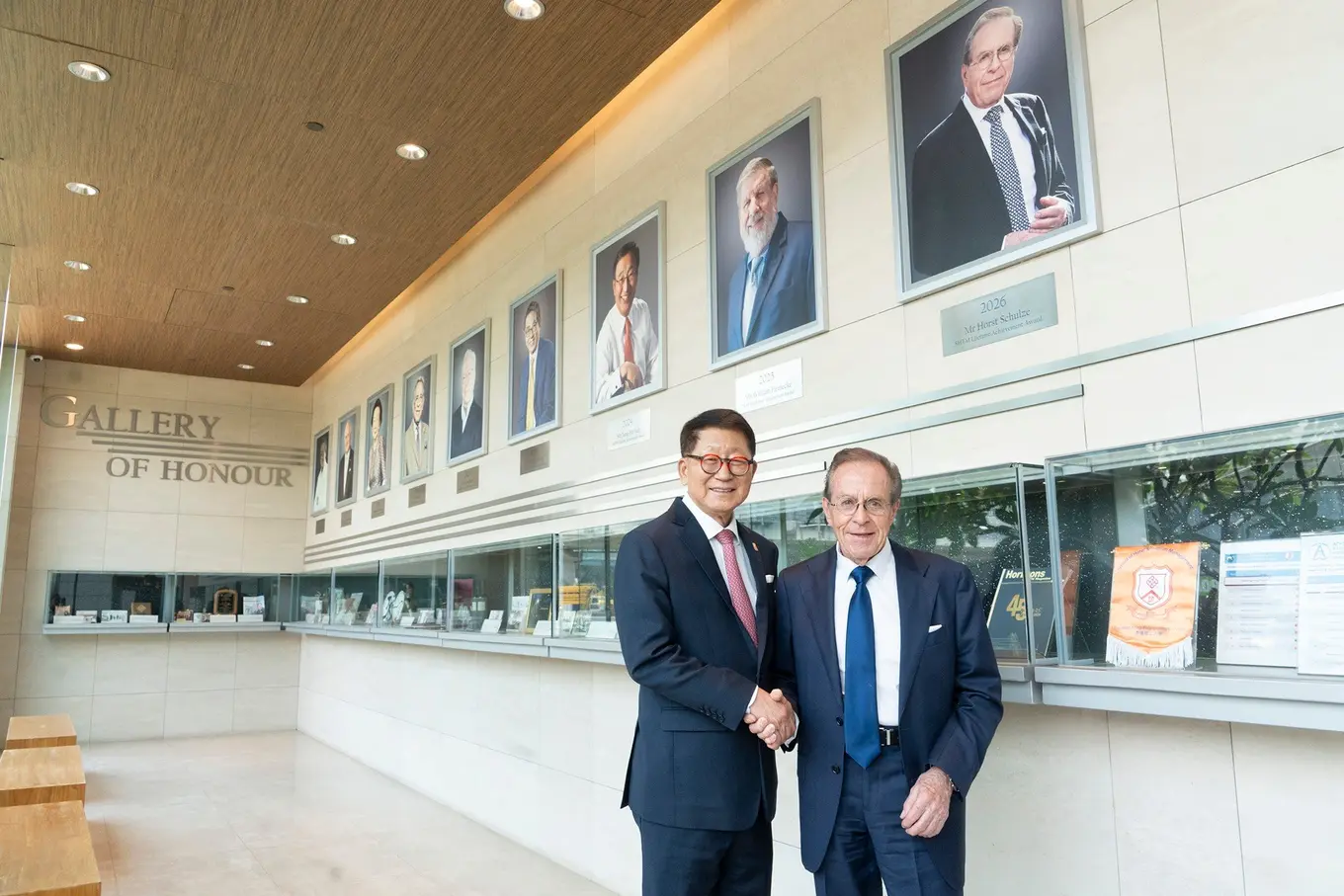
Horst Schulze, the founding architect of Ritz-Carlton’s service culture and founder of Capella Hotel Group, was inducted into the Gallery of Honour at the School of Hotel and Tourism Management at The Hong Kong Polytechnic University on 5 June 2026, receiving the school’s Lifetime Achievement Award at a gala dinner marking the occasion.
The induction places Schulze alongside a peer group that includes Adrian Zecha, Ho Kwon Ping of Banyan Tree Holdings and William Heinecke of Minor International, each recognised for reshaping the global industry in distinct ways. It is a measured honour: the Gallery does not induct frequently, and its selectivity is part of what lends the recognition weight.
Schulze was a founding member of The Ritz-Carlton Hotel Company in 1983 and served as its President and Chief Operating Officer, overseeing a global operation with revenues of approximately US$2 billion. What he built during that period was not simply a successful hotel brand. It was a replicable model of service culture whose mechanics, thinking and vocabulary have since been absorbed by virtually every serious operator in the luxury tier.
The Ritz-Carlton became the first, and remains the only, hotel company to win the Malcolm Baldrige National Quality Award twice, in 1992 and 1999. That distinction was not incidental to Schulze’s leadership. The Baldrige criteria are heavily weighted toward workforce practices: leadership culture, employee engagement, training systems and the translation of organisational values into consistent frontline behaviour. Winning it once demonstrates intent; winning it twice demonstrates that the culture had been institutionalised rather than performed.
At the centre of that culture was a philosophy Schulze had articulated as a teenager working as a busboy in Germany: ‘We are ladies and gentlemen serving ladies and gentlemen.’ The phrase addressed something that the industry had often treated as peripheral: the dignity and professional standing of the people doing the work. Schulze’s argument was that service excellence and employee respect were not competing priorities but the same priority, expressed at different levels of the organisation.
That framing had substantial workforce implications, and still does. In an industry that continues to struggle with retention, recruitment and the perceived social status of hospitality roles, Schulze’s model of internal culture as competitive advantage carries direct relevance for HR leaders today. His approach placed frontline staff at the centre of brand delivery rather than at the bottom of an operational hierarchy, and structured training and recognition systems accordingly.
After leaving Ritz-Carlton in 2005, Schulze founded Capella Hotel Group, building a portfolio of properties known for cultural authenticity and personalised service. The Capella brand extended his service philosophy into a smaller, more curated context, demonstrating that the principles were not scale-dependent.
He has since pursued a parallel career as a writer and educator. His 2019 book, ‘Excellence Wins’, sold over 100,000 copies and reached an audience well beyond hospitality. In 2022, Auburn University named its hospitality faculty The Horst Schulze School of Hospitality Management. He currently serves on the International Advisory Board of the SHTM, the body that has now formally recognised him.
SHTM Dean Professor Kaye Chon described Schulze as a ‘visionary in luxury hospitality’ whose ‘exceptional leadership and unwavering commitment to quality have profoundly shaped the global hospitality landscape.’ Claire Chiang, SHTM School International Advisory Board Chairman and Co-founder of Banyan Group, used the occasion to connect individual legacy with institutional purpose, noting that Schulze’s recognition aligns with the school’s broader mission of developing future industry leaders.
Schulze himself, in his acceptance remarks, offered a framing that is worth registering for senior executives: ‘Hospitality is ultimately about people, creating meaningful experiences through genuine care and service excellence.’ He added that he was ‘especially encouraged’ by the school’s commitment to nurturing future leaders ‘who will carry our industry forward with integrity, passion and purpose.’
For HR directors and workforce strategists in hospitality, the Schulze induction is more than a historical footnote. The structural problems he spent his career solving, whether in attracting talent, retaining staff, translating values into daily behaviour or building cultures that outlast individual leaders, remain the defining challenges of the sector. His body of work offers a tested framework, not a nostalgic one.