How to run inclusive multilingual hotel briefings
A briefing is only useful if colleagues can understand it and ask questions. A practical approach for multilingual hotel teams, without relying on nods or one bilingual employee.
 Team WINC Wire
6 min read
A pre-service briefing can sound efficient while leaving several colleagues unsure what to do. The manager speaks quickly, uses local shorthand and asks whether everyone understands. The room nods. Later, the same instruction is interpreted in three different ways.
Multilingual hotel team briefings need preparation, more than volume or repetition. The aim is shared understanding of the work and a safe way to ask questions, without treating language confidence as a measure of ability or commitment.
Find out which communication barriers actually exist
Ask colleagues how they prefer to receive work information. Speaking, reading and writing confidence may differ. Someone who comfortably handles guest conversations may find a dense technical notice difficult. Another colleague may read the briefing accurately but need more time to respond aloud.
Do not infer language needs from nationality, surname or accent. Ask about the task and format, not whether someone is “good at English”. Check hearing, vision and digital access too, because translation alone will not resolve every communication barrier.
Map the briefing audience across shifts, including temporary colleagues who join a service team. Identify where new starters receive local vocabulary, whom they can ask for clarification and whether important updates reach people who missed the live briefing.
Set a higher standard for safety-critical information
The Health and Safety Executive says employers must provide information workers can understand. It need not always be written or in English, provided work instructions, risks, safety measures and emergency procedures are communicated clearly. This is a duty in the Great Britain health and safety context, not merely a communication preference.
Routine service updates and safety instructions need different controls. A changed meeting-room allocation may be clarified quickly. An unfamiliar chemical, allergen procedure or emergency instruction requires the appropriate competent lead to verify both the content and how understanding will be checked.
The methods below are editorial good practice. Follow the hotel’s approved safety, food safety and emergency procedures, and obtain local advice where legal requirements differ. Never use a short briefing as a substitute for training required for a task.
Write the core message before translating it
Prepare one short source version. State what has changed, who needs to act, what they should do and where to get help. Use familiar verbs and one instruction per sentence. Replace “action this going forward” with a precise task and timing.
Remove idioms, jokes that carry operational meaning and unexplained abbreviations. “Give the rooms a once-over” leaves too much room for interpretation. Name the check and reference the approved checklist instead. Keep numbers, locations and times explicit.
Use a small vocabulary list for recurring hotel terms. Explain local room names, equipment labels and escalation roles. Keep the list current when departments change terminology. Consistency is especially useful when the same update is delivered by several supervisors.
Translate deliberately and check the result
Choose support according to the consequence of misunderstanding. A competent bilingual colleague may help with a routine message if they agree, have time and understand the subject. Specialist or safety-critical content may require a suitably qualified translator or interpreter and review by the relevant operational expert.
Automated translation can assist preparation, but an unchecked output should not become the authoritative version of a critical instruction. Product names, measurements, negation and technical terms deserve particular attention. Have a competent reviewer compare the meaning against the approved source.
Keep a version date and owner on every translation. When the source changes, update or withdraw all language versions together. Otherwise, a clear translation can become a reliable delivery mechanism for an outdated instruction.
A bilingual colleague should not become the hotel’s permanent unofficial translation service. Discuss workload, recognition, confidentiality and cover. Provide another route when that person is off shift or the subject involves a sensitive employment matter.
Make the live briefing easier to follow
Choose a location where colleagues can hear and see the speaker without competing equipment noise. Stand where everyone can see the relevant visual aid. Speak at a measured pace and pause between points rather than repeating the entire message more loudly.
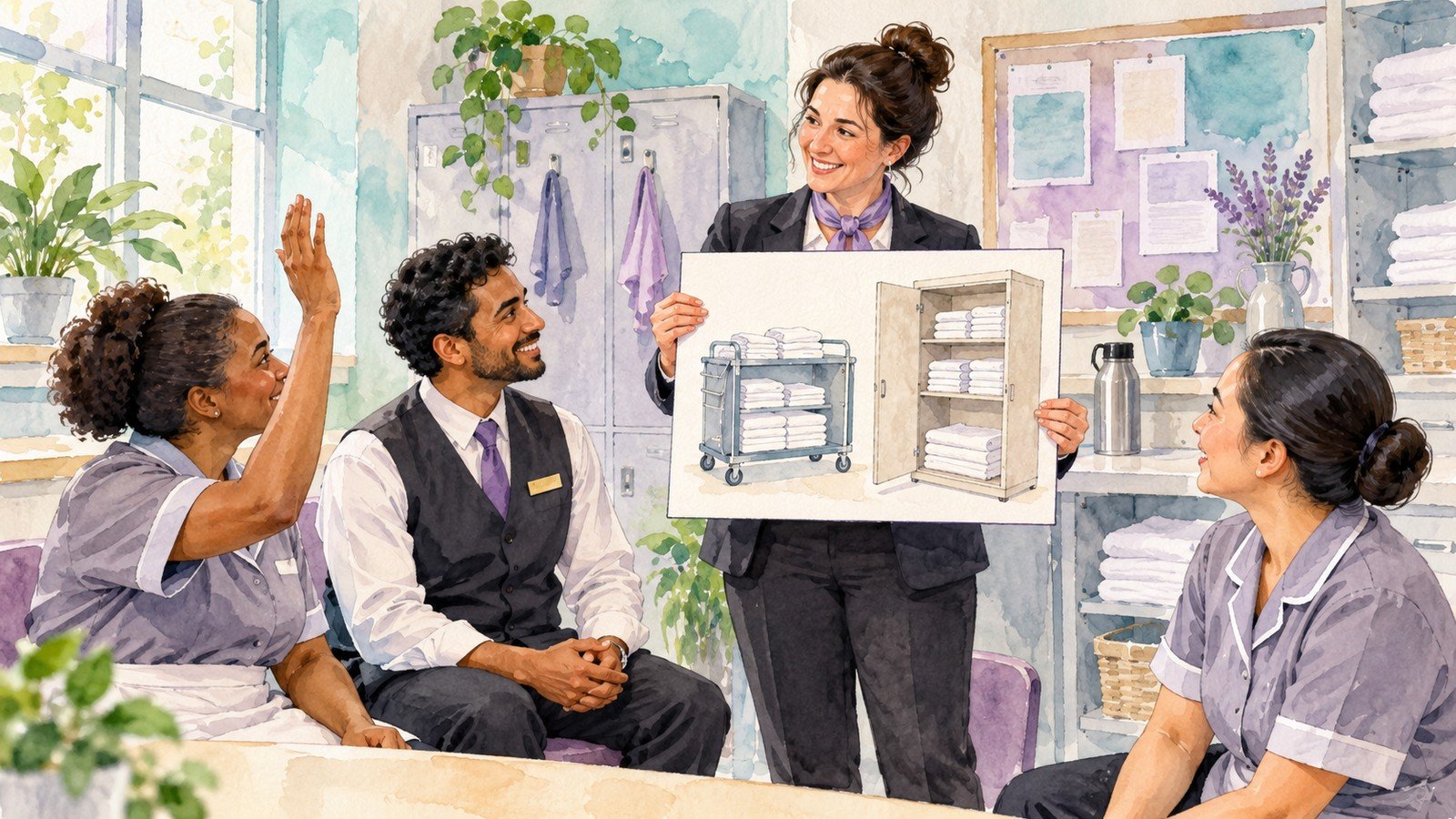
Show the object or location when that helps. A marked photograph can clarify which storage cupboard is changing. Use recognised safety signs correctly rather than inventing decorative icons for hazards. Ensure visual material is accessible to colleagues who cannot rely on it.
Keep the essential message short enough to repeat consistently at the next shift. More detail can sit in an accessible reference document. WINC Wire’s discussion of communication across dispersed teams reinforces the wider need for deliberate channel choices; frontline briefings also need physical access and suitable timing.
Check understanding without putting people on trial
“Does everyone understand?” gives little evidence. Instead, ask colleagues to explain the next step or show the approved task, where appropriate and safe. Frame the check around the clarity of the briefing: “I want to check I explained this well. What happens first?”
Use the same respectful approach with everyone, rather than singling out people with a particular accent. For complex work, arrange individual confirmation or supervised practice through the relevant training process. A fluent answer to one question does not establish competence for the whole task.
Allow questions afterwards through a named person or accessible channel. Some colleagues need processing time, privacy or translated support before asking. Thank people who identify ambiguity and correct the source message for every affected shift.
A reusable multilingual briefing card
- Purpose: What colleagues need to know or do differently.
- Audience: Departments, shifts and temporary staff included.
- Core message: Three or fewer clear actions, with necessary timing and location.
- Support: Language versions, visual aids and accessibility arrangements.
- Verification: Content owner, translation reviewer and current version.
- Understanding check: The question or safe demonstration that tests the instruction.
- Questions: Named contact and alternative route outside the live session.
- Catch-up: How absent colleagues receive the same approved message.
Hypothetical example: changing the linen collection point
A fictional hotel’s housekeeping team must use a different linen collection room during refurbishment. The first announcement says to use “the old service area”, a name newer colleagues do not recognise.
The supervisor rewrites the instruction with the room number and start time, adds a checked photograph and arranges language support where needed. Colleagues identify the location on the floor plan and explain whom to contact if the route is blocked. The night team receives the same version.
The correction is modest, but it targets the real problem: shared meaning. It does not label the original confusion as an employee attitude issue or assume that repeating the announcement solved it.
Review the briefing, not the employee’s accent
Track recurring questions, outdated materials and missed shift coverage. Ask whether staff could obtain clarification without embarrassment. Avoid ranking employees by language confidence when evaluating a communication process.
Inclusive hospitality workplaces are built through everyday choices. A briefing earns its place when colleagues leave knowing what to do, where uncertainty remains and who will help them resolve it.
Sources
AI-generated editorial illustration.