
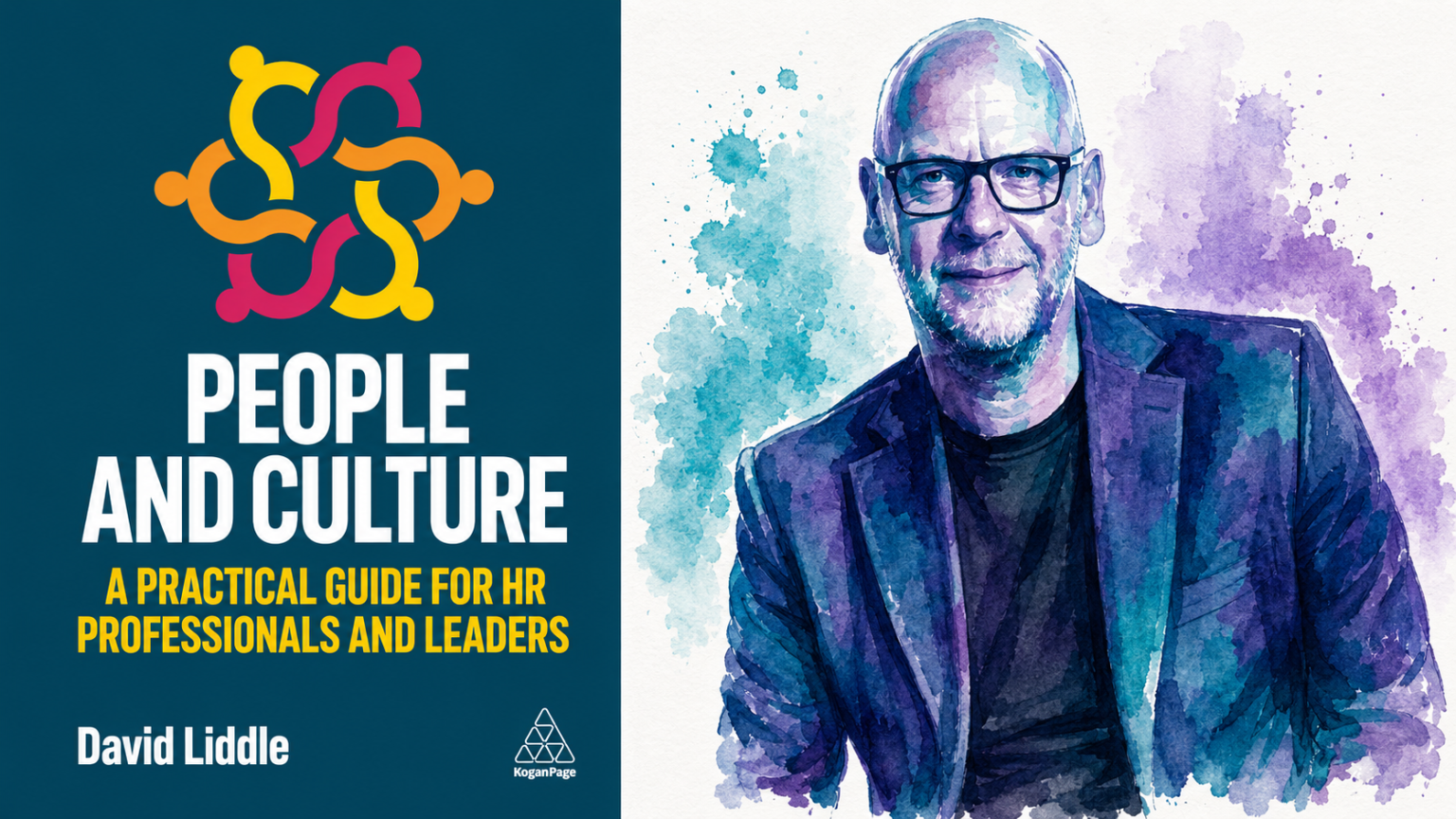
Most organisations claim that people are their greatest asset. Fewer behave as though this is true when decisions become difficult, performance slips or conflict appears.
That gap between stated values and everyday practice is the territory David Liddle explores in People and Culture: A Practical Guide for HR Professionals and Leaders. His argument is that organisations can no longer afford to treat people strategy and workplace culture as related but separate concerns. They are part of the same system, and both must be connected to how the organisation is led, governed and measured.
Liddle is not calling for HR to adopt a more fashionable title while continuing with the same processes. He is proposing a more fundamental shift from traditional HR towards an integrated people and culture function. In this model, the function is not simply responsible for policy, compliance and resolving problems after they have escalated. It becomes an active partner in shaping purpose, behaviour, performance and the employee experience.
That distinction matters because culture is often treated as something intangible. It appears in engagement surveys, leadership presentations and carefully worded values statements, but becomes harder to locate when employees encounter unfairness, destructive behaviour or poor management. Liddle brings culture back into the daily operation of the organisation, where it belongs.
At the centre of the book is the People and Culture Operating Model, a framework designed to align purpose, values, strategy, behaviour and organisational systems. The ambition is significant. Rather than offering another isolated programme, Liddle asks leaders to examine the way the entire organisation supports or undermines the culture it claims to want.
The book is strongest when challenging the tendency to treat workplace problems as individual failures. A difficult employee, an underperforming team or a toxic manager may certainly require intervention. However, Liddle encourages readers to look beyond the visible behaviour and consider the system around it. What is being rewarded? What is being ignored? Which processes create fear, silence or competition? What messages are leaders sending through their actions rather than their speeches?
This systems perspective prevents the book from becoming a collection of familiar recommendations about kindness and employee engagement. Liddle is clearly committed to fair, inclusive and compassionate workplaces, but he does not present these qualities as alternatives to commercial performance. His case is that healthy cultures strengthen performance because people are more likely to contribute, collaborate and adapt when they experience fairness, trust and psychological safety.
For HR professionals, this is both validating and uncomfortable. It validates the argument that people and culture work should sit at the centre of organisational strategy. It is uncomfortable because strategic influence brings greater accountability. A function that wants to shape the organisation cannot retreat into process when decisions become politically difficult.
Liddle is particularly critical of systems built primarily around control, risk mitigation and retribution. Formal grievance, disciplinary and performance processes may be necessary, but they can become default responses to issues that might have been resolved earlier through dialogue, mediation and skilled management.
This does not mean abandoning accountability. One of the useful tensions in the book is the relationship between compassion and performance. A people-centred organisation is not one in which poor behaviour is excused or standards disappear. It is one in which accountability is exercised fairly, consistently and with an understanding of context.
The book also pays close attention to leadership. Culture cannot be delegated to HR while senior leaders behave in ways that contradict it. Leaders shape culture through what they reward, tolerate, discuss and avoid. Their behaviour determines whether stated values become operating principles or corporate decoration.
Liddle introduces integrative leadership as part of this shift. The approach asks leaders to combine commercial judgement with emotional intelligence, systems thinking and the ability to handle disagreement constructively. These capabilities are sometimes described as soft skills, although there is nothing particularly soft about confronting damaging behaviour or facilitating a conversation between people who no longer trust one another.
Artificial intelligence and digital transformation also appear in the book, but not as a distraction from its central argument. Liddle treats technology as part of the wider organisational system. AI may improve efficiency and decision-making, but it can also magnify bias, distance and poor leadership when adopted without care. The challenge is to use technology in ways that support human judgement and connection rather than weaken them.
The practical value of the book becomes most visible in its final playbook. Readers are given tools for reviewing culture, identifying toxic behaviours and planning change. This makes the book more useful than a purely conceptual argument, although the breadth of its ambition means that some topics inevitably receive less depth than specialist readers might prefer.
There is also a risk that organisations will adopt the language of people and culture without accepting the structural change behind it. Renaming HR is easy. Challenging executive behaviour, redesigning performance systems and giving employees a meaningful voice are considerably harder. Liddle understands this, but readers should expect implementation to be less orderly than any operating model can suggest.
The book is written primarily for HR leaders, chief people officers, CEOs and senior executives. It will be especially useful for organisations reviewing their HR operating model or attempting to repair a culture in which trust has deteriorated. Consultants, mediators and organisational development professionals will also recognise many of the challenges it addresses.
People and Culture makes a persuasive case that culture should not be treated as a project, benefit or employee engagement initiative. It is the cumulative result of how an organisation makes decisions and how people experience those decisions.
The future of HR may well be people and culture. The harder question is whether organisations are prepared to change more than the name of the department.
Where to buy:
UK: Kogan Page
US: Amazon US
India: Amazon India
Australia: Booktopia