
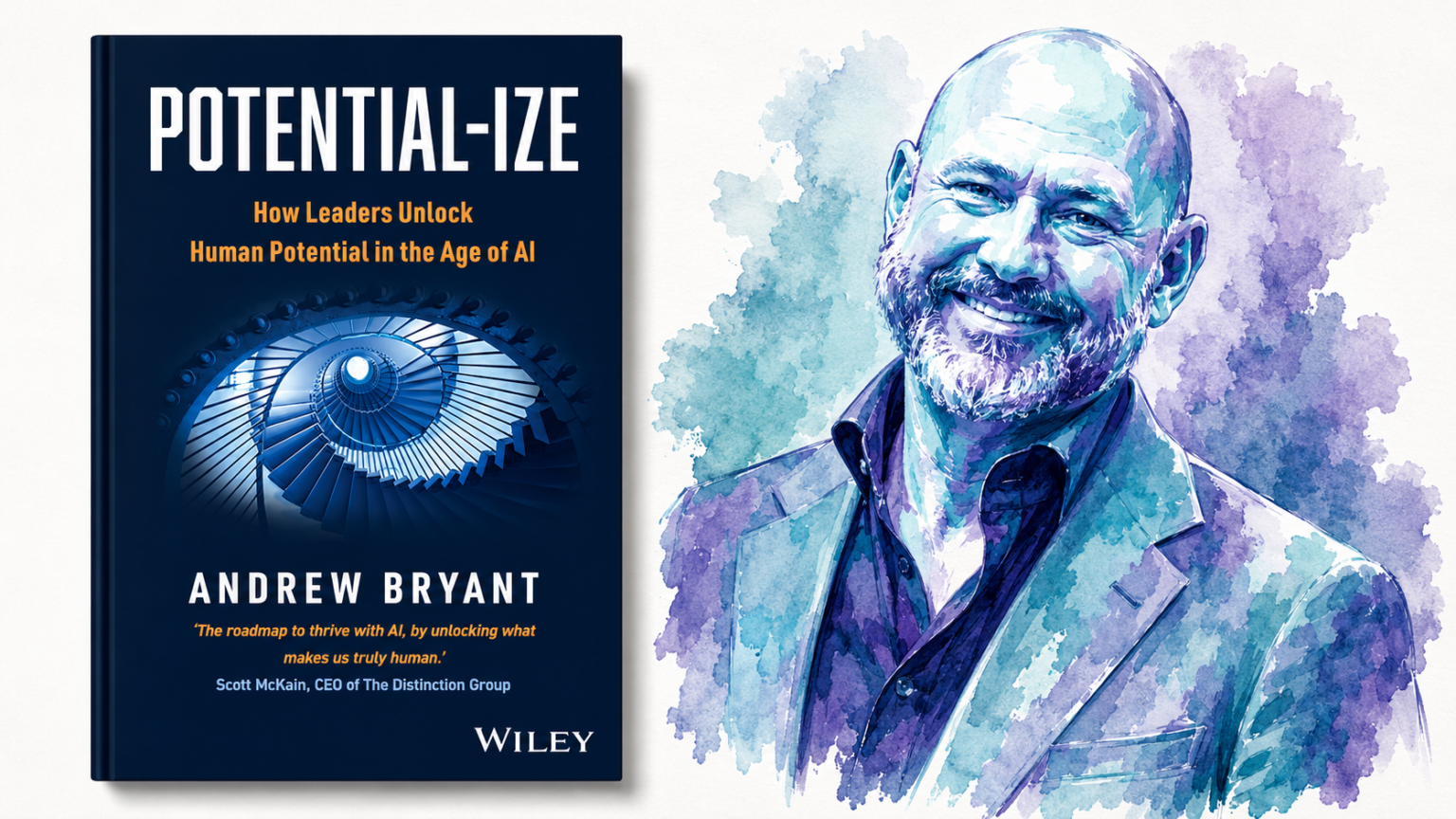
Artificial intelligence has created no shortage of anxious conversations about the future of work. Will people become less valuable? Which skills will still matter? How quickly can organisations automate what employees currently do?
Andrew Bryant believes these questions begin in the wrong place.
In Potential-ize: How Leaders Unlock Human Potential in the Age of AI, he argues that the central challenge is not whether humans can outperform machines. It is whether leaders can create the conditions in which people continue to learn, adapt and contribute as technology becomes more capable.
Bryant describes the current moment as a “potential crisis”. Organisations are adopting new tools at speed, but many are still relying on outdated assumptions about talent and development. Potential is treated as something a person either possesses or lacks, often identified through performance reviews, succession plans or the instincts of a senior leader. Bryant’s alternative is more dynamic. Potential is not a fixed quality waiting to be discovered. It is a process that can be deliberately expanded.
That distinction gives the book its strongest idea. When organisations label a small group of employees as “high potential”, they can unintentionally turn development into a prediction rather than a practice. Bryant shifts the emphasis from identifying who might succeed to asking what conditions help more people become capable of succeeding.
The book organises this approach through the six-part IGNITE framework. Leaders are encouraged to inspire people to take ownership of their stories, guide them through feedback and mentorship, nurture growth through belief and belonging, integrate human intelligence with artificial intelligence, transform adversity into development and evaluate progress through continuous learning.
Frameworks built around memorable acronyms are common in business books, and IGNITE occasionally carries the familiar neatness of one. Human development rarely follows six orderly stages. People resist feedback, confidence fluctuates and organisational culture has an inconvenient habit of undermining even the most carefully designed leadership programme.
Bryant, however, does not present the framework as a quick intervention. He is explicit that unlocking potential requires sustained effort. The concepts may be accessible, but their application depends on repeated practice, honest reflection and leaders who are prepared to examine their own behaviour.
That focus on self-leadership runs throughout the book. Bryant’s argument is that people cannot credibly develop others if they remain unwilling to take responsibility for their own thinking, actions and influence. Leadership therefore begins before the team meeting, the performance conversation or the transformation programme. It begins with the leader’s capacity to manage themselves.
This becomes particularly relevant in the book’s treatment of AI. Bryant avoids presenting technology as either a corporate miracle or an approaching catastrophe. Instead, he positions it as an amplifier. AI can extend human capability, but it can also expose weak judgement, poor culture and unclear leadership more quickly than previous technologies did.
That is a useful corrective to the tendency to discuss AI primarily through tools, productivity and efficiency. Organisations may become faster without becoming wiser. They may automate processes while leaving employees uncertain about their purpose, development or future value. Bryant’s answer is not to slow technological progress, but to pair it with a more deliberate investment in human capability.
The book also challenges several comfortable assumptions about performance. Bryant argues that competence often precedes passion, rather than the other way around. People may become more engaged as they develop mastery, receive meaningful feedback and see evidence of their own progress. Waiting for employees to arrive fully motivated allows leaders to avoid their responsibility for creating the conditions in which motivation can grow.
His discussion of adversity follows a similar line. Challenges can reveal and develop capability, but only when they are accompanied by sufficient support. Pressure without support becomes exhaustion. Support without challenge becomes stagnation. Effective development sits somewhere between the two, which sounds straightforward until a leader has to judge what a particular person needs at a particular moment.
For HR and people leaders, the book provides a practical language for examining talent development in the AI era. It raises useful questions about whether organisations are developing genuine adaptability or simply sending employees on more courses. It also asks whether performance systems reward curiosity, resilience and collaboration, or continue to privilege predictable execution in roles that may soon change.
The emphasis on belief and belonging is especially important. Employees are unlikely to experiment, ask difficult questions or acquire unfamiliar skills if failure carries disproportionate consequences. Leaders who demand innovation while punishing uncertainty are not unlocking potential. They are teaching people to protect themselves.
The book draws on research, leadership experience and stories from business leaders, mentors and elite athletes. This variety helps prevent the framework from feeling entirely corporate, although some readers may find that the breadth occasionally limits how deeply individual ideas are explored. Those seeking a technical guide to AI implementation will also need to look elsewhere. This is a leadership book shaped by the arrival of AI, not a manual for adopting specific technologies.
I would recommend Potential-ize to senior leaders, HR professionals, executive coaches and managers responsible for developing others. It will be particularly useful for organisations reconsidering what talent, performance and leadership should mean when technical skills are changing faster than traditional development systems can accommodate.
Its central message is both reassuring and demanding. AI does not make human potential irrelevant. It makes careless leadership more difficult to excuse.
The future of work may be shaped by increasingly intelligent machines. Whether people continue to grow within it remains a human responsibility.
Where to buy:
UK: Amazon UK
US: Amazon US
India: Amazon India