
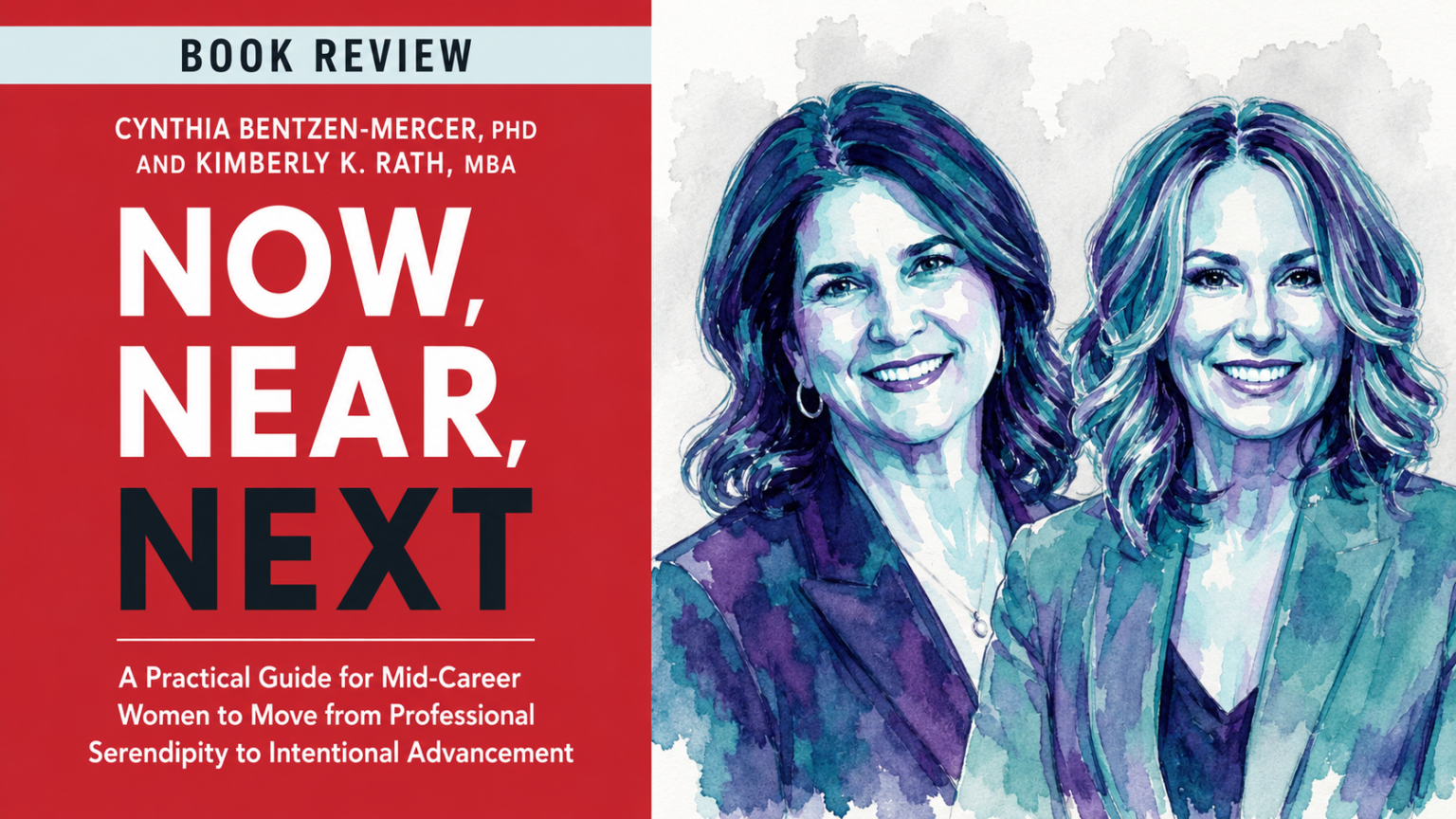
Mid-career is a strange place to stand. You are experienced enough to know what you are capable of, established enough to appear successful and often far too busy to ask whether the career you have built is still taking you somewhere you want to go.
That tension sits at the heart of Cynthia Bentzen-Mercer and Kimberly K. Rath’s Now, Near, Next. Written for women navigating the middle stages of their professional lives, the book explores what happens when hard work, reliability and the occasional fortunate opportunity are no longer enough. Its argument is simple: a career shaped by professional serendipity eventually needs to become one shaped by intention.
The authors organise this transition around three horizons. “Now” asks readers to understand their present position, recognise the strengths they have accumulated and let go of the guilt or regret attached to earlier decisions. “Near” focuses on preparation, relationships and the actions that can create momentum. “Next” turns towards courage, resilience and the calculated risks required to pursue a more deliberate future.
It is a sensible framework, partly because it acknowledges that career change rarely begins with a perfectly formed five-year plan. Most people do not wake up one morning with complete clarity, a colour-coded strategy and an accommodating diary. They begin with a persistent sense that something needs to change.
What elevates the book beyond familiar advice about confidence and ambition is its emphasis on self-agency. Bentzen-Mercer and Rath are not simply encouraging women to dream more boldly. They ask readers to examine the choices, habits and assumptions that have shaped their working lives, then convert that reflection into specific action.
This is particularly relevant for mid-career women, who are rarely lacking in responsibility. By this stage, many have become the dependable person at work and at home. They manage teams, projects, deadlines, family commitments and the invisible labour that accompanies all of them. Their own development is easily postponed because there is always something more urgent to complete for somebody else.
The book is at its strongest when addressing this gap between capability and intentionality. Being good at your job can keep you busy without necessarily moving you forward. Reliability earns more responsibility. Expertise makes you indispensable. Neither automatically produces visibility, influence or advancement.
Bentzen-Mercer and Rath also challenge the comforting belief that good work will eventually speak for itself. Good work is useful, but it is not especially talkative. Careers also depend on relationships, advocacy, self-knowledge and the ability to communicate what you want before other people make assumptions on your behalf.
For HR professionals and organisational leaders, the book offers a valuable reminder that ambition does not always present itself in conventional ways. A woman may be ready for greater responsibility without constantly announcing it. She may have developed leadership skills through non-linear roles, caregiving, community work or assignments that offered influence without a formal title. Organisations that only recognise the loudest or most traditional expressions of potential will continue to overlook capable people.
The structure is accessible, with three sections and practical reflections designed to help readers move from insight to action. This is not a book that benefits from being rushed through in a weekend and placed neatly on a shelf. Its usefulness depends on whether readers pause, complete the exercises and answer the uncomfortable questions honestly.
There are moments when the language of empowerment feels familiar. Readers who already consume a great deal of career development literature will recognise themes around identifying strengths, building supportive relationships and taking calculated risks. Some of the examples also reflect an American corporate context, although the underlying challenges translate easily across workplaces in the UK, India, the Middle East and elsewhere.
I would recommend Now, Near, Next to women who feel professionally restless but cannot yet articulate what needs to change. It will also be useful for those returning after a career break, considering a leadership role, questioning whether they have outgrown their organisation or simply wondering why success no longer feels as satisfying as it once did.
Coaches, mentors and HR leaders may also find the framework useful when supporting women whose careers appear stable from the outside but have begun to feel directionless from within.
The book does not insist that every reader needs a dramatic reinvention. Its message is more measured. Understand where you are. Pay attention to what is approaching. Decide what you want to move towards.
Professional serendipity may help build a career. It should not be allowed to design the whole thing.
Where to buy:
UK: Amazon UK
US: Amazon US
India: Amazon India
Australia: Amazon Australia